The story of Ansett Airlines begins not in an airport, or even a hangar, but on the dusty country roads of Victoria’s Western District. In the early 1930s, a young entrepreneur named Reginald Myles Ansett was running a successful road passenger and freight business so successful, in fact, that it began eating into the revenue of Victorian Railways. The state government responded as governments often do: it legislated the problem away, introducing regulations that effectively strangled private road transport operators out of business.
Reg Ansett wasn’t the type to take that lying down. He noticed something important: aviation was regulated at the federal level, not the state level. Victoria couldn’t touch him there. In 1935, he incorporated Ansett Airways Pty Ltd, and on 17 February 1936, a single-engine Fokker Universal monoplane lifted off from Hamilton, Victoria, bound for Melbourne. Australia’s most storied airline had taken its first breath.
Early Wings: Building a Network
The initial route was modest a 180-mile hop between Hamilton and Melbourne but the public took to it immediately. The airline floated on the stock exchange just two years after its founding in 1937, a remarkable vote of confidence. As the route network grew across regional Victoria and beyond, Ansett imported Lockheed L-10 Electra aircraft from the United States, sleek twin-engine monoplanes that were among the most modern airliners of the era.
Then came the war.
When Australia entered World War II, Reg Ansett made the pragmatic decision to suspend most scheduled services and charter his aircraft to the United States Army Air Forces, which was a far more lucrative arrangement than flying farmers and salesmen between country towns. Only the original Hamilton–Melbourne service kept running throughout the conflict.
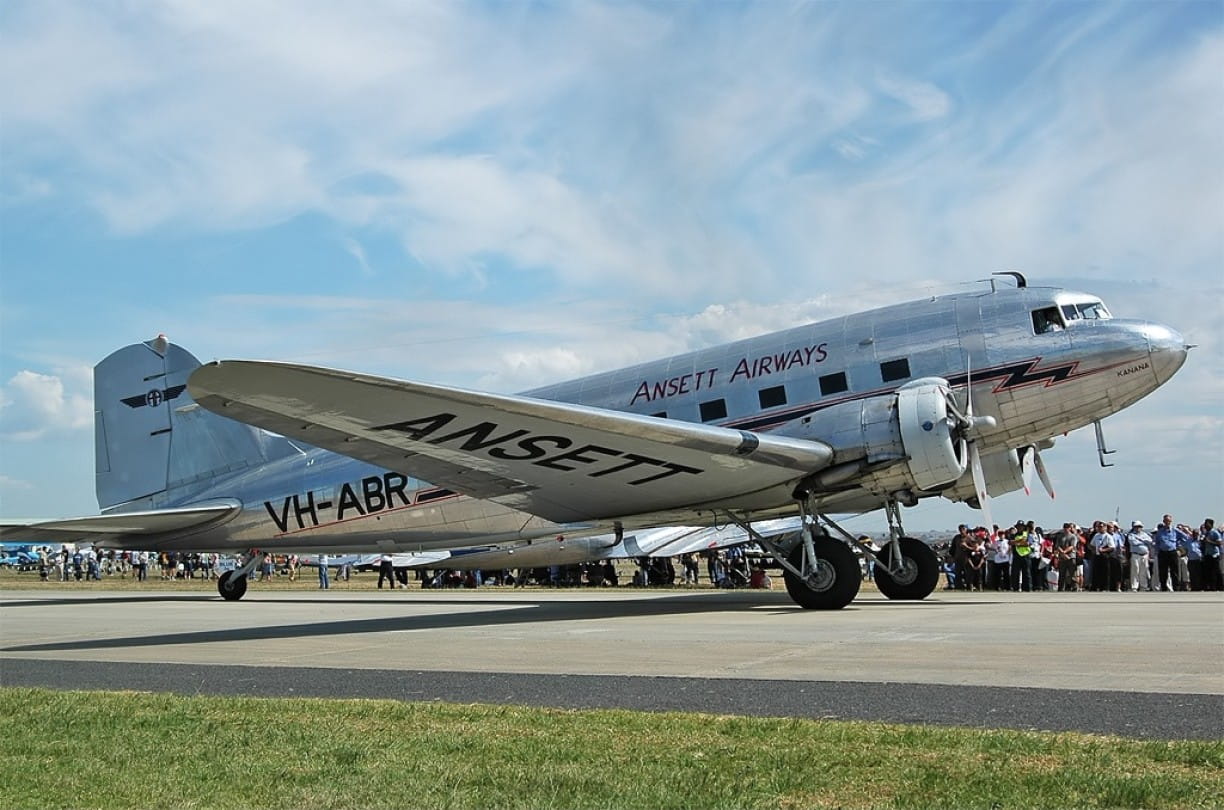
When peace came in 1945, Ansett faced a sky that looked very different from the one he’d left. The Australian domestic market was now dominated by two powerful players: Australian National Airways (ANA), backed by a consortium of British-financed shipowners, and the newly created Trans-Australia Airlines (TAA), a government-owned carrier that the Chifley Labor government had established after being blocked by the High Court from nationalising aviation outright. Ansett carved out a niche operating budget interstate services using war-surplus Douglas DC-3s, later augmented by Convair CV-340s acquired from Braniff International. It was a scrappy existence in the shadow of the big two but it kept the airline alive, and alive meant dangerous.
The ANA Takeover: Becoming a Giant
By the mid-1950s, ANA was struggling. The Menzies government, while favouring TAA for the healthy dividends it paid into public coffers, was deeply uncomfortable with the prospect of a state-owned monopoly if ANA collapsed. They needed a strong private-sector alternative. Ansett was the obvious candidate.
In October 1957, after fierce resistance from ANA’s board, Reg Ansett completed the purchase of Australian National Airways for £3.3 million a deal backed by financial supporters including the Shell Oil Company, and quietly encouraged by the Menzies government. The combined entity was renamed Ansett-ANA, and overnight, a regional budget carrier had become one of Australia’s two dominant domestic airlines.
The merger also ushered in the era of the Two Airlines Policy a piece of regulatory architecture that would define (and ultimately distort) Australian aviation for the next three decades. Under this policy, only Ansett and TAA could operate interstate trunk routes. Fares, schedules, and even aircraft types had to be mutually agreed and government-approved. The two airlines flew the same aircraft, at the same times, to the same destinations, for identical fares. Competition existed only on paper.
For Ansett’s shareholders, this was paradise. For Australian travellers, it was a polite cartel.
Consolidation and Control
With the trunk routes locked down, Reg Ansett set about eliminating competition on the regional periphery. He acquired Adelaide-based Guinea Airways (rebranded as Airlines of South Australia) and Sydney-based Butler Air Transport (rebranded as Airlines of New South Wales), the latter through a takeover that involved covertly engineering employee share purchases and busing those employees to a general meeting in Sydney to vote in favour of selling out a piece of corporate theatre that was breathtaking in its audacity.
He later acquired Perth-based MacRobertson Miller Airlines, purchasing a 70% stake in 1963 and completing the full acquisition in 1968. Unlike the other regional buys, MMA retained its own identity for many years before finally becoming Airlines of Western Australia in 1981, eventually absorbed fully into the Ansett family.
There was also the curious matter of the flying boats. Ansett operated a remarkable service from Rose Bay in Sydney to Lord Howe Island using Short Sandringham four-engine flying boats great lumbering machines from another age that continued splashing down in the Pacific until 1974, when Lord Howe Island finally got a proper airport. It was the kind of operation that would be utterly uneconomical today, but it was also genuinely romantic, and it speaks to the character of early Ansett: pragmatic, resourceful, and occasionally magnificent.
The airline was renamed Ansett Airlines of Australia on 1 November 1968, shedding the ANA name entirely, and entered the jet age properly that same decade. Reg had famously lobbied against TAA’s attempt to introduce the French Caravelle jet in the early 1960s, citing the engineering leap required, convincing the government to authorise turboprops instead. The delay meant that Australia didn’t get pure jet domestic services until October 1964, when both TAA and Ansett launched Boeing 727 operations on exactly the same day, at the same time, on the same route (Melbourne–Sydney), in perfect Two Airlines Policy symmetry. Ansett won a coin toss to land first, and so technically inaugurated the jet age in Australian domestic aviation.
The Abeles Era: New Owners, New Ambitions
In 1979, Reg Ansett lost control of the company he had spent four decades building. Peter Abeles, the forceful Hungarian-born shipping and transport magnate who ran TNT, and Rupert Murdoch’s News Corporation engineered a takeover, with Abeles assuming operational control of the airline. Reg Ansett, then 69, was eased out of the company that bore his name.
The early 1980s brought a polished new identity. Landor Associates, the international design firm, gave Ansett a sleek new livery: plain white fuselages, a distinctive serif logotype, and a blue tailfin featuring a stylised Southern Cross. It was clean, confident, and authoritative the visual language of a mature national carrier. The livery rolled out across the entire Ansett family, with regional subsidiaries rebranded as Ansett NSW, Ansett NT, Ansett WA, and so on, bringing the sprawling empire into one coherent brand.
New aircraft poured in during the mid-1980s. Ansett ordered Boeing 737s, bought five of the brand-new Boeing 767s (to an unusual specification that retained a flight engineer, a concession to union agreements), and in 1985 placed a landmark order worth over A$1 billion for Airbus A320s the first major Airbus order by an Australian carrier. These aircraft, branded the “Skystar,” began replacing the ageing 727 fleet from the late 1980s. Two years later came an order for 21 new Boeing 737-300s and 737-500s.
Also in 1985, Ansett became a launch customer for the Fokker 50 turboprop, investing in the regional fleet that served smaller communities across the continent.
In 1987, the airline crossed the Tasman Sea for the first time, establishing Ansett New Zealand with a small fleet of Boeing 737s flying between Auckland, Wellington, and Christchurch. Australian aviation was going international.
Deregulation and Distress
The late 1980s brought structural change that would eventually prove fatal. Australia’s Two Airlines Policy was wound back, with the Airlines Agreement Act 1992 formally opening the domestic market to new entrants. Ansett, which had lived its entire profitable adult life under regulatory protection, now faced genuine competition for the first time.
Worse, the new ownership had been spending freely in directions that had nothing to do with running an airline. Ansett Transport Industries (ATI) had invested in America West Airlines, which duly went bankrupt. It had sunk money into Hamilton Island Resort, which also went bankrupt. And in what was perhaps the most extravagant single decision of the era, Ansett paid a reported A$70 million to be the official airline of the 2000 Sydney Olympics a spectacular act of brand spending that contributed nothing to the bottom line and a great deal to the company’s mounting debt.
The Boeing 767 fleet, meanwhile, was proving to be a headache. The unusual three-crew specification made them expensive to operate, and the aircraft were plagued by maintenance issues and groundings at the worst possible times.
In 1996, Air New Zealand purchased a 50% stake in Ansett while News Corporation retained its share. Anti-monopoly requirements forced the separation of Ansett Australia and Ansett New Zealand, which was a somewhat absurd corporate untangling of a subsidiary that had only existed for nine years. In February 2000, Air New Zealand bought out News Corporation’s remaining share for A$680 million outbidding Singapore Airlines, which had offered A$500 million and took full ownership.
The timing could hardly have been worse.
The Final Years: Running Out of Sky
Full Air New Zealand ownership coincided with the worst possible convergence of pressures. Deregulation had opened the door to new competitors: Impulse Airlines and, more significantly, Virgin Blue, Richard Branson’s low-cost carrier that launched in 2000 with a directness and aggression that the market had never seen. Qantas, which had itself been privatised and was growing increasingly confident, was taking market share from the other end.
Ansett’s cost structure was ruinous. Years of union agreements had produced a workforce that was substantially overpaid relative to competitors. The fleet was ageing. Maintenance standards slipped dangerously — in April 2001, the entire Boeing 767 fleet was grounded by the Civil Aviation Safety Authority (CASA) after serious maintenance irregularities were uncovered, a catastrophic reputational blow just months before collapse.
Air New Zealand attempted to cut costs while maintaining revenue. As the AirlineGeeks account put it: this did not work. Cost-cutting hurt service; hurt service lost passengers; lost passengers meant less revenue; less revenue meant deeper cuts. Ansett was losing an estimated A$1.3 million every single day.
A rescue bid by Singapore Airlines, who proposed injecting A$500 million into Air New Zealand (with the expectation it would flow through to Ansett), was vetoed by the New Zealand government on competition grounds. In September 2001, the New Zealand government instead bailed out Air New Zealand by acquiring 83% of the airline for NZ$885 million but the deal explicitly excluded Ansett. The Australian government declined to offer a equivalent rescue.
Then came 11 September 2001.
The September 11 attacks devastated the global aviation industry in ways that could not have been anticipated. For an airline already running on empty, it was a death blow. Air travel demand collapsed. Insurance and fuel costs surged. Three days later, Ansett was finished.
Collapse: 14 September 2001
On 12 September 2001, Air New Zealand placed Ansett under voluntary administration. On 14 September, administrators determined the airline was not viable to continue operations it had no funds to cover fuel, catering, or staff wages. The fleets of Ansett and its subsidiaries (Hazelton Airlines, Kendell Airlines, Skywest, and Aeropelican) were grounded. Aircraft in the air at the moment of the decision flew on to their destinations; everything else stopped.
The human toll was staggering. Approximately 16,000 people lost their jobs the largest single corporate collapse in Australian history to that point. Many employees arrived for work that morning, not knowing the airline had ceased to exist. At the State Library of Victoria in Melbourne, thousands gathered in shock and fury. Hundreds of thousands of passengers were left stranded across the country and around the world.
A brief, scaled-back “Ansett Mark II” operation began on 1 October 2001, attempting to restart services with a small fleet on key trunk routes. It lasted less than six months. The last Ansett flight touched down on 5 March 2002. Liquidation followed.
The subsidiaries had varied fates. Kendell Airlines and Hazelton Airlines merged to form Regional Express (Rex), which continues flying today. Skywest was eventually absorbed into what became Virgin Australia Regional Airlines. Aeropelican was acquired by other interests.
Legacy
Ansett’s physical legacy is scattered and poignant. Hulks of its Boeing 767s were shipped to aircraft boneyards in the American desert. Ground equipment sat idle at airports across Australia. The name faded from the departure boards quickly, utterly, in the way that only corporate deaths can manage.
But its cultural legacy is more durable. For a generation of Australians, Ansett was half the sky. It was the airline you flew when you didn’t fly Qantas, which meant it was the airline half the country flew, all the time, for decades. Its Golden Wing Club loyalty programme had hundreds of thousands of members. Its staff, despite the union complexities that contributed to the airline’s cost problems, were generally regarded as warm, professional, and genuinely proud of their work.
The collapse also reshaped Australian aviation permanently. The duopoly of Ansett and Qantas was replaced by the duopoly of Qantas and Virgin Australia, which evolved from the ashes of Virgin Blue. Competition intensified, fares fell, and passenger numbers increased though whether Australians are better served by the current duopoly than the old one is a question aviation economists still debate.
As for Reg Ansett himself knighted in 1969, stripped of his airline in 1979, dead in 1981 he never saw the full arc of what he had built and what was lost. Perhaps that was a mercy.
Ansett Airways operated its first flight on 17 February 1936. Its last flight touched down on 5 March 2002. For 65 years, it was part of what it meant to fly in Australia.
Sources: Wikipedia/Ansett Australia, AirlineGeeks.com, Britannica, Clarence Valley Independent, Craig Hill