There are moments in technological history when progress feels less like a straight line and more like a brief, brilliant spike. The Concorde was one of those moments. For nearly three decades, it didn’t just redefine air travel, it re imagined what was possible. And ever since its final flight in 2003, a quiet, uncomfortable question has lingered in the aviation world: Did we already experience the golden age of flight?
The Promise of Speed
When the Concorde entered commercial service in 1976, it shattered expectations literally and figuratively. Cruising at over twice the speed of sound (Mach 2.04), it could carry passengers from London to New York in under 3.5 hours. Crossing the Atlantic faster than the Earth rotated beneath you wasn’t just convenient; it felt like science fiction made real.
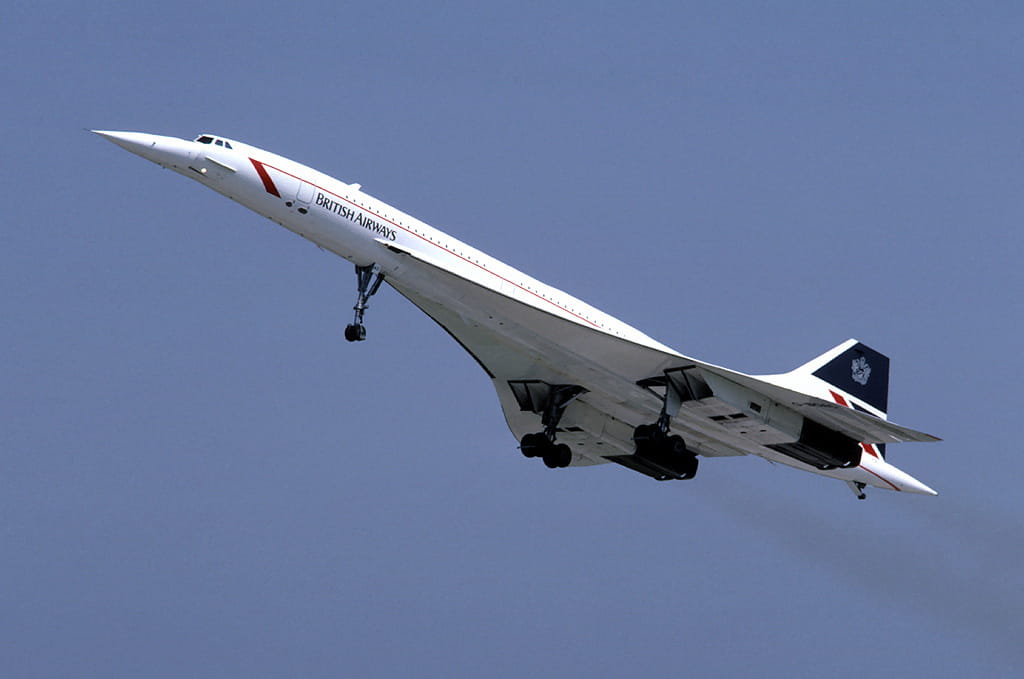
But Concorde wasn’t just about speed. It represented a mindset. Engineers, governments, and airlines were willing to take enormous risks to push boundaries. The aircraft itself was a marvel of design: a slender delta wing, a drooping nose for visibility, and engines that turned raw fuel into controlled thunder. Everything about it signaled ambition.
Luxury in the Sky
Flying on Concorde wasn’t simply transportation it was an experience reserved for a select few. Tickets were expensive, yes, but what passengers received in return was unmatched prestige. The clientele ranged from business magnates to celebrities, all drawn by the allure of beating time itself.
Cabins were compact compared to today’s widebodies, but that was part of the charm. This wasn’t about stretching out it was about arriving before you left, about sipping champagne at 60,000 feet while watching the curvature of the Earth darken the sky above you.
Modern aviation has, in many ways, democratized travel. Flights are cheaper, safer, and more accessible than ever. But in doing so, something intangible was lost: the sense that flying could be extraordinary.
Why It Ended
If Concorde was so revolutionary, why didn’t it define the future?
The answer lies in a mix of economics, environmental concerns, and timing. The aircraft consumed vast amounts of fuel, making it costly to operate especially as oil prices fluctuated. Sonic booms restricted overland supersonic travel, limiting viable routes. And after the tragic Air France Flight 4590 crash in 2000, public confidence waned.
By 2003, both British Airways and Air France retired their fleets. The decision was practical. But it also marked the end of an era where speed was the ultimate goal.
The Shift to Efficiency
Since Concorde’s retirement, aviation has moved in a different direction. Today’s aircraft, like the Boeing 787 Dreamliner and Airbus A350 prioritize fuel efficiency, range, and passenger comfort. They are technological masterpieces in their own right, but they serve a different philosophy: optimisation over ambition.
Instead of cutting flight times in half, we’ve focused on making long-haul journeys more bearable. Better seats, quieter cabins, improved air quality. These are meaningful advancements but they don’t inspire awe in quite the same way.
A Peak, or a Pause?
To say aviation “peaked” with Concorde is both true and misleading. In terms of sheer boldness, the willingness to challenge physical limits it arguably represents a high-water mark. We went faster in the 1970s than we do today in commercial travel, which feels counterintuitive in an age of exponential technological growth.
Yet, progress hasn’t stopped. It has simply changed direction.
Today, there are whispers of a supersonic revival. Companies like Boom Supersonic are working to bring faster-than-sound travel back, this time with sustainability and economics in mind. NASA is experimenting with “quiet supersonic” technology to reduce sonic booms. The dream hasn’t died it’s just waiting for the right conditions to return.
The Legacy of Concorde
Concorde’s true legacy isn’t just its speed, but what it symbolised. It proved that commercial aviation could be daring, glamorous, and unapologetically forward-thinking. It showed that the sky wasn’t a limit, but a starting point.
In today’s world of budget airlines and incremental upgrades, that spirit feels distant. But it hasn’t disappeared. It lives on in every attempt to rethink flight, in every engineer who asks, “Why not faster?”
Maybe aviation didn’t peak with Concorde. Maybe it simply set a standard we’ve yet to match again, and when we finally do, it will feel less like progress and more like coming home.

Photo By Eduard Marmet – https://www.airliners.net/photo/British-Airways/Aerospatiale-BAC-Concorde-102/1406076/L