Before Air New Zealand: A Country That Needed Wings
New Zealand is one of the most geographically isolated nations on earth. Two major islands, a scattering of smaller ones, sitting alone in the South Pacific with Australia 2,700 kilometres to the northwest and the next meaningful landmass, South America, more than 8,000 kilometres to the east. Before aviation, reaching New Zealand from anywhere of consequence meant weeks at sea. The country’s internal distances were also formidable: in the 1930s, moving goods or people from Invercargill to Auckland, from Wellington to Christchurch, still meant lengthy rail and ferry journeys through difficult terrain.
Aviation wasn’t a luxury for New Zealand, it was, eventually, a structural necessity.
The story that led to Air New Zealand begins with a series of smaller enterprises and governmental decisions in the 1930s. Two domestic carriers, East Coast Airways and Cook Strait Airways, merged in January 1936 to form Union Airways of New Zealand, the country’s first serious domestic airline. Union Airways flew de Havilland aircraft on coastal and inter-island routes, and its significance in the Air New Zealand lineage is that it became the sole New Zealand partner in the international enterprise that would follow.
Because the more dramatic origin story, the one with the flying boats, the coral atolls, and the southern winter crossings of the Tasman, begins on a morning in April 1940, and involves an aircraft called Aotearoa.
TEAL: The Flying Boat Era Begins
Tasman Empire Airways Limited (TEAL) was created by intergovernmental agreement, a treaty signed in London on 10 April 1940 by the governments of the United Kingdom, Australia, and New Zealand. The shareholding at formation split the airline between BOAC (38%), Qantas (23%), the New Zealand government (20%), and Union Airways (19%). The name was deliberately imperial in its sweep: Tasman, for the sea it would cross; Empire, for the world it aspired to connect.
The world it was born into was at war. Within weeks of TEAL’s formation, Italy had entered the conflict and the Mediterranean was closed to civilian air traffic. The grand vision of a New Zealand–England air service via the Empire flying boat network collapsed almost before it began. TEAL was left with two aircraft and one route: Auckland to Sydney.
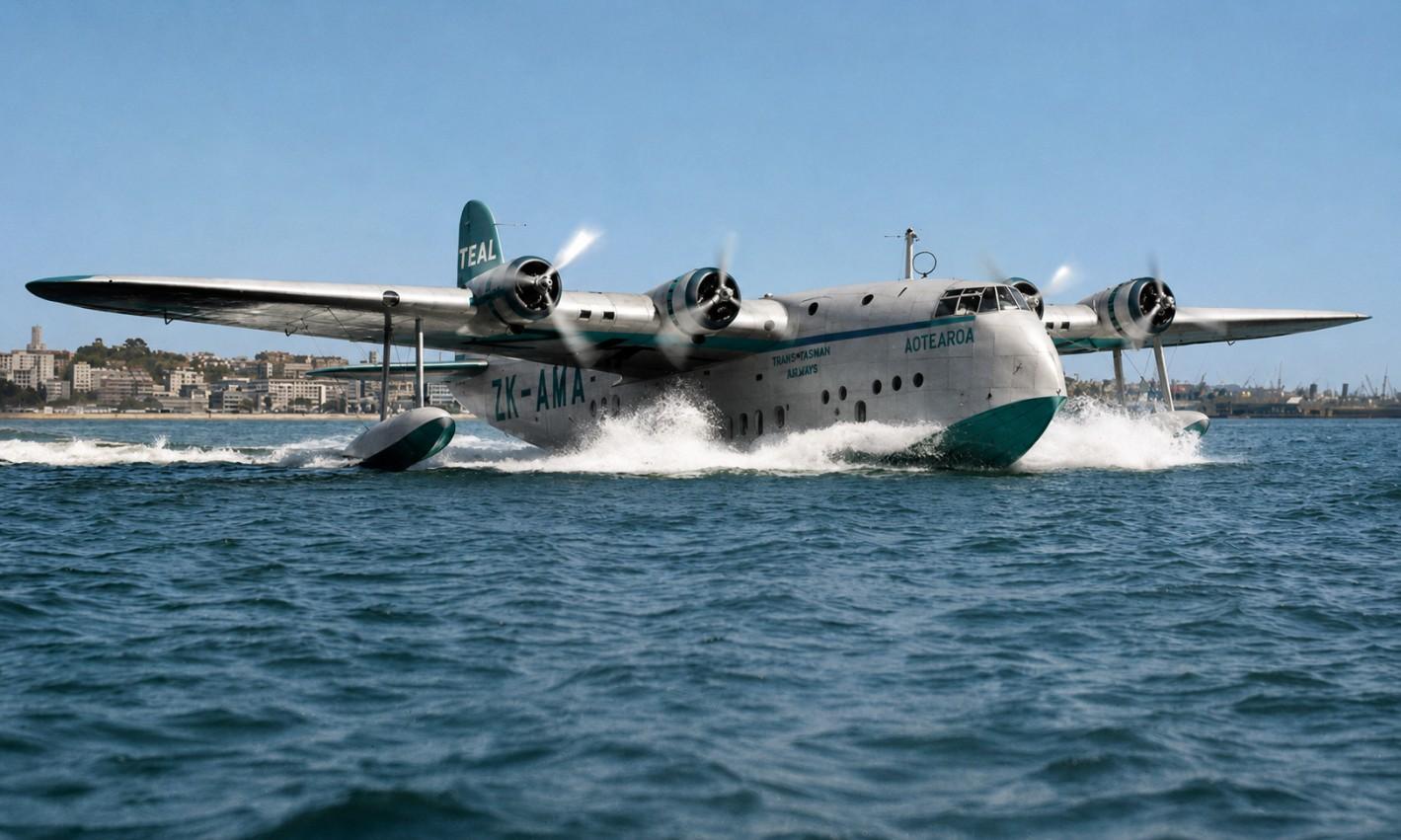
On 30 April 1940, the Short S.30 Empire flying boat Aotearoa lifted off from Mechanics Bay in Auckland Harbour, carrying ten passengers bound for Rose Bay in Sydney. The journey took around seven and a half hours, a miracle of modernity for people who had previously crossed the Tasman by ship in three to four days. TEAL was in the air.
The two flying boats, Aotearoa and Awarua, would remain New Zealand’s only scheduled link to the outside world throughout the war. The Tasman crossing was not a gentle route. The sea that Abel Tasman had navigated in 1642 was notorious for violent weather, and the flying boats were pushed well beyond the comfortable operating envelope their designers had in mind for coastal hops. Navigation was by celestial observation and dead reckoning. Weather forecasts were unreliable. In his memoir, former TEAL chief pilot Oscar Garden recalled hitting a severe headwind halfway across after receiving what he described as a “crook weather forecast” pilots navigating by guesswork and experience over a featureless, storm-prone ocean.
Despite the hazards, the route turned a profit. TEAL’s first annual report, dated March 1941, recorded 130 trans-Tasman flights completed, 174,200 miles flown, 1,461 passengers carried, and a profit of £31,479. For a two-aircraft airline operating through a world war, this was a remarkable result.
During the war years, TEAL undertook special charter and reconnaissance flights to New Caledonia, Fiji, Tonga, Samoa, and Hawaii in support of the Allied war effort. In June 1944, the airline crossed the Tasman for the 1,000th time.
Post-War: The Sandringhams, Solents, and the Coral Route
When peace came in 1945, TEAL re-equipped. The pre-war Empire flying boats were supplemented and then replaced by Short Sandringhams, military Short Sunderlands converted to civilian passenger use, and then, from 1949, by the magnificent Short S.45 Solent. Four Solents were acquired, their Bristol Hercules engines carrying 45 passengers at 200 mph a significant advance on the earlier types, and cutting the trans-Tasman crossing to around six and a half hours.
The Solents were, by any measure, among the most luxurious aircraft of the post-war era. Food was prepared from scratch in a proper galley. The crew numbered eight, including a flight steward and two stewardesses. The aircraft had a range of 3,000 miles and flew at an altitude that kept most passengers above the worst of the weather. One Solent arrived from the factory setting a new trans-Tasman record of 5 hours and 37 minutes.
While the rest of the world was rapidly converting to land-based aircraft after the war, TEAL, caught between political pressures, British post-war manufacturing loyalty, and the genuine practicalities of landing at Pacific island destinations that lacked runways, remained loyal to flying boats longer than almost any other major carrier. When BOAC abandoned flying boats entirely in 1950, leaving TEAL as the sole remaining operator of long-haul flying boat services, it was a distinction that cut both ways: romantic, certainly, but also increasingly anachronistic.
The act of imagination that redeemed the flying boat era entirely was the Coral Route.
In 1951, TEAL expanded beyond the Auckland–Sydney service to launch a scheduled air connection through the islands of the South Pacific that had no equivalent anywhere on earth. The Coral Route, inaugurated on 27 December 1951, flew from Auckland to Papeete in Tahiti via Suva in Fiji, Apia in Samoa, and Aitutaki in the Cook Islands, stopping where the land allowed, landing in the lagoon where it didn’t. Tahiti had no airstrip; the Solent simply alighted in the harbour.
The route was a sensation. The South Pacific in the early 1950s was, for most travellers, as remote and exotic as anywhere on earth. New Zealand and American soldiers had returned from the war with stories of these islands, and tourism was beginning to stir. TEAL promoted the Coral Route with a brilliance of visual marketing, the posters from this era are among the finest pieces of airline graphic design ever produced, depicting turquoise lagoons, palm trees, and the white hull of the Solent banking above reef-rimmed atolls. The stop at Aitutaki Lagoon, for refuelling, allowed passengers to swim in one of the most beautiful bodies of water on the planet while the aircraft took on fuel.
The food served aboard the flying boats was, by all accounts, extraordinary. It was cooked from scratch, not reheated. The still-reflecting wartime military culture meant the crew uniforms gave passengers confidence that the people in charge could handle whatever the Tasman threw at them.
TEAL’s former chief pilot once described flying the route in terms that captured what it meant: not just a mode of transport, but an experience that turned the journey itself into the destination.
The Transition to Land Planes
The flying boat era could not last indefinitely. Land-based airliners were faster, cheaper to operate, more commercially flexible, and available to land at the growing network of paved runways being built across the Pacific in the 1950s. TEAL made the transition gradually and with some reluctance.
In 1954, Douglas DC-6 landplanes, acquired from the defunct British Commonwealth Pacific Airlines, replaced the flying boats on the Auckland–Sydney service. The change was commercially necessary but aesthetically jarring: the massive Solents descending to Auckland Harbour had been one of the great spectacles of the era, drawing crowds to the waterfront to watch. Their replacement by a conventional airliner arriving at a conventional airport was progress, but a certain magic departed with them.
One Solent, Aranui, soldiered on for the Coral Route service after the DC-6s took over the Tasman crossing, because Tahiti still had no airstrip. She continued in this role until September 1960, when the new Faaa Airport in Papeete was completed and the era of scheduled flying boat services finally came to an end. The last Coral Route flying boat service operated on 16 September 1960 — the final scheduled long-range flying boat flight in the world. Aranui is now preserved in TEAL colours at the Museum of Transport and Technology in Auckland.
The DC-6 era was transitional. In 1959, TEAL updated its fleet with Lockheed L-188 Electra turboprops, which reduced the Auckland–Sydney flying time to under four hours and carried 71 passengers. The Electra was an excellent aircraft, but it arrived just as the jet age was beginning to make turboprops seem insufficient for international routes.
Becoming Air New Zealand
The ownership structure of TEAL had been shifting throughout the 1950s. In 1953, the Australian government bought 50% of the airline, with New Zealand holding the other half. In 1961, the New Zealand government bought out Australia’s share entirely, taking full ownership of what had been a three-government enterprise.
On 1 April 1965, TEAL was renamed Air New Zealand Limited. The change of name reflected a change of purpose: the new airline would no longer be just the trans-Tasman carrier it had been since 1940, but New Zealand’s flag carrier to the world. The ambition was right; the timing was fortunate.
In September 1963, Air New Zealand had signed a contract for three Douglas DC-8-52 jet airliners, the first jets the airline would operate. The first DC-8 arrived at Auckland in July 1965, and on 3 October 1965 the inaugural jet service operated from Christchurch to Sydney. More significantly, on 14 December 1965, Air New Zealand launched its first Auckland–Los Angeles service, flying via Nadi and Honolulu, opening the Pacific to the airline in a way that the Electras and DC-6s had never been able to do. Services to Hong Kong via Manila and Singapore followed in early 1966.
The DC-8 fleet gradually expanded through the late 1960s, with additional aircraft acquired from United Airlines. In July 1966, one of the DC-8s was lost in a training accident at Auckland an engine throttle setting inadvertently entered reverse thrust during a simulated single-engine takeoff, and the aircraft cartwheeled along the runway. Two of the five crew members died. It was a sobering moment for a young jet operator.
NAC and the Domestic Merger
Alongside TEAL and then Air New Zealand, New Zealand had maintained a separate domestic carrier since 1947. The National Airways Corporation (NAC) was formed when the government nationalised Union Airways and several smaller operators, creating a state-owned domestic network. NAC built an impressive fleet over the years: de Havilland Dragon Rapides, DC-3s, Vickers Viscounts, Fokker Friendships, and eventually Boeing 737s. In the late 1940s it also briefly provided international services to Pacific Island destinations, using converted RNZAF Short Sunderlands.
By the 1970s, NAC and Air New Zealand were increasingly intertwined in operations, with shared resources and coordination. The relationship was cooperative but strategically awkward. When NAC announced plans to purchase Boeing 727-200s, which would have given it meaningful medium-range international capacity, and expressed interest in reclaiming some of its old Pacific Island routes, Air New Zealand objected. The argument made to the government was familiar: one national airline would better serve New Zealand’s interest than two.
The government agreed, and on 1 April 1978, NAC was absorbed into Air New Zealand. The merged airline used NAC’s “NZ” prefix for domestic flights and retained Air New Zealand’s old TEAL “TE” prefix for international services until October 1990, when “NZ” became universal. For the first time, New Zealand had a single airline connecting its internal network to the world.
The DC-10 Era and the Erebus Disaster
In 1973, Air New Zealand took delivery of eight McDonnell Douglas DC-10-30s, which replaced the aging DC-8 fleet on long-haul routes and brought the distinctive koru design to the airline’s tail, a stylised Maori waka (canoe) stern post replacing the Southern Cross that had appeared previously. The koru would become one of the most recognisable livery elements in Pacific aviation.
The DC-10s opened new routes into Asia and allowed expansion of the trans-Pacific service. But they are inseparable, in Air New Zealand’s history, from the blackest day in the airline’s existence.
In 1977, Air New Zealand began offering scenic sightseeing flights over Antarctica, a remarkable concept that gave ordinary New Zealanders the chance to view the ice continent from low altitude, guided by luminaries including Sir Edmund Hillary, who had stood on top of the world less than twenty years earlier. The flights were hugely popular. The scenery was, by all accounts, incomparable.
On 28 November 1979, Air New Zealand Flight TE901 departed Auckland at 8 am for a scheduled sightseeing flight over Antarctica. On board were 237 passengers and 20 crew. The aircraft was a DC-10-30, registered ZK-NZP. The flight path was supposed to take the aircraft over McMurdo Sound and the flat water and sea ice of the Ross Ice Shelf, a route that kept the aircraft safely above terrain.
Unknown to the pilots, who had never flown the Antarctica route before, the navigation centre in Auckland had made a change to the flight path coordinates that morning, believing it was a minor correction. It was not minor. The new coordinates shifted the aircraft’s planned track 31 miles to the east, directly towards the 3,794-metre summit of Mount Erebus on Ross Island.
The aircraft flew into cloud over Ross Island. At 12:49 pm New Zealand Standard Time, flying in whiteout conditions with the terrain invisible against a white sky, the DC-10 struck the lower slopes of Mount Erebus at 1,460 metres altitude. The aircraft disintegrated on impact. All 257 people on board, 237 passengers and 20 crew, were killed instantly.
It remains New Zealand’s deadliest peacetime disaster.
The aftermath was as protracted and painful as the crash itself. A Royal Commission of Inquiry headed by Justice Peter Mahon examined the evidence and, in 1981, published findings that were devastating not just in their technical conclusions but in their language. Justice Mahon found that the crash was caused by the unexplained alteration of the flight coordinates, and that in the subsequent inquiry, Air New Zealand had been guilty of “an orchestrated litany of lies.” His findings were partly overturned on appeal, in a legal process that consumed years and deeply divided New Zealand. The question of who bore moral responsibility for 257 deaths, the navigation staff who changed the coordinates, the company that failed to inform the crew, or the system that put an uninformed flight crew over unfamiliar terrain in bad weather, was debated for decades. It was not until 2019 that the New Zealand government and Air New Zealand formally apologised to the families of those who died.
The Antarctica sightseeing programme was terminated. It has never been resumed.
Privatisation, ETOPS, and the Boeing 747
The 1980s were years of fleet transition and structural change. The DC-10s were replaced by Boeing 747-219s from 1981, with the last DC-10 leaving the fleet in 1986. The 747 brought a step change in capacity and comfort to Air New Zealand’s long-haul routes, and the airline’s first service to London, via Papeete and Los Angeles, operated in 1982, making Air New Zealand a genuinely global carrier for the first time.
In 1985, the airline took delivery of its first Boeing 767-200ERs, which filled the medium-range gap that the DC-8 and DC-10 retirements had created. The 767 was crucial to one of the airline’s genuine technological achievements. Air New Zealand, alongside Qantas, became an early pioneer of ETOPS Extended range Twin engine Operations which allowed twin-engine aircraft like the 767 to fly oceanic routes previously restricted to three and four-engine types. By demonstrating the reliability needed to operate safely on routes two, three, and eventually four hours’ flying time from a diversion airport, Air New Zealand helped establish the regulatory and operational framework that now underpins virtually all long-haul operations by twin-engine jets. Without ETOPS, the economics of modern long-haul aviation built around the 777, 787, and A350 would be unrecognisable.
In October 1989, the New Zealand government privatised Air New Zealand, selling to a consortium led by Brierley Investments, which retained 65% of the company. The remaining shares were distributed to the public, airline staff, and strategic investors including Qantas (19.9%), Japan Airlines (7.5%), and American Airlines (7.5%). A government “Kiwi share” retained special powers to ensure New Zealanders kept majority control. The airline was simultaneously listed on the New Zealand Stock Exchange.
In 1990, Air New Zealand received its first Boeing 747-400, but industrial action by pilots and cabin crew over pay rates for the new long-range aircraft meant the first delivery had to be leased to Cathay Pacific while negotiations continued. When the dispute was resolved, the 747-400 entered mainline service later that year, becoming the backbone of the international fleet for the next two decades.
The Ansett Disaster and Re-Nationalisation
The 1990s brought aggressive expansion. New routes opened to Kuala Lumpur, Bangkok, Denpasar, Nagoya, Taipei, Seoul, and Osaka. The 767-300ER allowed a second daily Los Angeles service via Honolulu. In 1999, Air New Zealand joined the Star Alliance, cementing its position within the global network aviation ecosystem alongside Lufthansa, United, Singapore Airlines, and others.
But the decade was also dominated by an Australian adventure that would nearly destroy the airline.
In 1995, Air New Zealand acquired a 50% stake in Ansett Australia, the struggling major domestic Australian carrier. In February 2000, it bought out News Corporation’s remaining share for A$680 million — outbidding Singapore Airlines, which had offered A$500 million, and took full ownership. It was the most ambitious acquisition in the airline’s history, and it was a catastrophic mistake.
The problems at Ansett were worse than Air New Zealand’s due diligence had revealed. The fleet was ageing. Maintenance standards were dangerously inadequate the entire Boeing 767 fleet was grounded by Australian aviation authorities in April 2001 after serious irregularities were found. The cost structure was ruinous. The airline was losing an estimated A$1.3 million per day. Air New Zealand’s attempts to cut costs while maintaining revenue proved futile. Competition from Qantas and the new entrant Virgin Blue intensified with every month.
Then came September 11, 2001.
In the days following the attacks on New York and Washington, global air travel demand collapsed. On 12 September 2001, Air New Zealand placed Ansett Australia into voluntary administration. The subsequent collapse of Ansett, Australia’s largest corporate failure to that point, leaving 16,000 people out of work, was the subject of our separate Ansett history. For Air New Zealand, the consequences were existential. The write-offs from the Ansett investment exceeded NZ$1 billion. The airline announced a loss of NZ$1.425 billion for the year.
On 4 October 2001, the New Zealand government intervened with a recapitalisation package of NZ$885 million, taking an 82% stake in the airline. Air New Zealand had been privatised twelve years earlier; now it was effectively re-nationalised. The government reduced its holding to 73% by 2013 and to approximately 51% by 2016, but retained majority ownership as the airline’s strategic anchor.
In 2002, a proposed alliance between Air New Zealand and Qantas, which would have seen the two flag carriers cooperate extensively on the trans-Tasman and elsewhere, was rejected by the New Zealand Commerce Commission and the Australian Competition and Consumer Commission on competition grounds. The rejection forced Air New Zealand to rebuild its competitiveness independently.
Rebuilding: The 21st Century
The post-Ansett decade was one of careful, deliberate reconstruction. Air New Zealand streamlined its domestic operations, remodelled its cabin products, and rebuilt its financial health. The airline also made a strategic decision that would define its reputation globally: it would invest heavily in the passenger experience and use innovative thinking as a point of difference in a market it couldn’t win on scale alone.
In 2010, Air New Zealand introduced the Skycouch, a row of economy seats engineered to convert into a flat sleeping surface for couples or families. It was the kind of product innovation that required genuine thinking about what economy passengers actually wanted on long overnight flights. The Skycouch became one of the most talked-about economy class innovations of its era and won significant industry awards.
In 2008, Air New Zealand conducted the world’s first commercial test flight using second-generation sustainable aviation fuel, a biofuel derived from jatropha, on a Boeing 747. The flight, operated on the Auckland–Wellington route, did not carry passengers but demonstrated the technical viability of blended biofuel in commercial jet engines. It positioned the airline as a pioneer in sustainable aviation years before the rest of the industry had made it a mainstream priority.
Air New Zealand had ordered Boeing 787-9 Dreamliners in 2004 as the launch customer for the -9 variant, a significant commitment that reflected confidence in Boeing’s composites technology and a desire for more fuel-efficient long-haul operations. Developmental delays in the base 787-8 pushed Air New Zealand’s deliveries out to 2014, but the aircraft, when it arrived, was transformative. The 787-9’s composite airframe, lower cabin altitude, higher humidity levels, and fuel burn improvement of around 20% per seat compared to the aircraft it replaced made a genuine difference to both passenger comfort and operating economics.
The airline subsequently emerged as one of the most thoughtful operators of the type, and one of the most vocal when problems emerged. In 2017 and 2018, Air New Zealand suffered engine failures on 787-9s caused by low durability in the Rolls-Royce Trent 1000 turbofan’s fan blades. The resulting mass groundings, required by regulation across all airlines using the Trent 1000, meant Air New Zealand had up to three 787s out of service simultaneously at peak periods, requiring the emergency lease of Boeing 777-300ERs to cover capacity. The experience reinforced the airline’s decision, when ordering additional 787-10s for fleet renewal in the 2020s, to switch to General Electric GEnx engines.
The 777-200ER fleet, which had served since 2005 on the long-haul network, was retired in 2020 earlier than planned, as the COVID-19 pandemic grounded most of the international fleet, and Air New Zealand took the opportunity to accelerate the retirement of its oldest widebodies. The pandemic was devastating for the airline: revenue collapsed, the London Heathrow slots were sold to United Airlines for US$27 million, and the long-running London route was cancelled as the travel restrictions made it unviable.
The Alliance, the Koru, and the Present
Air New Zealand’s Star Alliance membership has been central to its commercial strategy since 1999, providing the global connectivity that a relatively small airline operating from one of the most isolated countries on earth could never achieve independently. Alliance partnerships give Air New Zealand passengers seamless connections through the major hubs of the northern hemisphere that the airline’s own route map cannot reach.
The airline’s domestic network remains one of the most comprehensive in the world for a country of New Zealand’s size, connecting 20 regions, including remote communities in the South Island and offshore islands that would otherwise have no practical connection to the national network. The ATR 72 and de Havilland Canada Dash 8-300 fleets Air New Zealand operates the world’s largest fleet of the Dash 8-300 variant serve this domestic and regional task.
In 2025, Air New Zealand was named the World’s Safest Airline by AirlineRatings.com, which evaluates 385 carriers against factors including incident history, fleet age, pilot training, and audit standards. It was the second consecutive year the airline received the top ranking narrowly ahead of Qantas, which had held the title for much of the previous decade. The airline has maintained a passenger fatality-free record in commercial operations since the Erebus disaster of 1979 a run of 46 years.
In 2025, the airline began a comprehensive nose-to-tail retrofit programme for its 787-9 fleet, introducing new cabin products across all classes for the first time in over fifteen years. The new cabin design incorporates materials and references derived from the textures, colours, and spatial qualities of Aotearoa New Zealand the fibrous warmth of native timbers, the blue-green of the Tasman, the silverfern patterns of the indigenous landscape. A fleet of 787-10s, ordered to replace the 777-200ERs and fitted with GEnx engines, is being delivered through the mid-2020s.
The koru on the tail the spiral fern frond that first appeared on the DC-10s in 1973, based on the Maori symbol of new life, growth, and strength remains unchanged.
Legacy: 85 Years and Counting
Air New Zealand’s history is, in many ways, a compressed version of New Zealand’s own history in the world: small, isolated, obliged to be resourceful; capable of great achievement precisely because the margin for mediocrity was always thin. A country of five million people cannot sustain a flag carrier through political will alone. It has to be good enough that people choose it over the alternatives.
The TEAL flying boats that crossed the Tasman in 1940, the Solents of the Coral Route that landed in Tahitian lagoons when there was nowhere else to land, the DC-10s that opened the Pacific to a new generation of travellers, the 747s that finally reached London and the 787-9s that continue to carry New Zealanders further and more comfortably than anything that came before: all of them are expressions of the same underlying ambition. To connect a small country at the bottom of the world to everything beyond its shores.
That ambition has produced disasters, as well as achievements. Mount Erebus remains the deepest wound in the airline’s history. The Ansett catastrophe nearly ended the airline altogether. But Air New Zealand survived both, and emerged from each more focused on what it actually did well.
Flying. And being unmistakably, distinctively, unapologetically from New Zealand.
Key Milestones
1936 — Union Airways of New Zealand founded (Air New Zealand’s earliest predecessor)
1940 — TEAL formed; inaugural Auckland–Sydney flying boat service, 30 April
1944 — TEAL’s 1,000th trans-Tasman crossing
1946 — NAC (National Airways Corporation) established as domestic carrier
1949 — Short Solent flying boats delivered; trans-Tasman record set
1951 — Coral Route inaugurated: Auckland to Tahiti via Fiji, Samoa, Cook Islands
1954 — DC-6 landplanes replace flying boats on Auckland–Sydney
1960 — Last Coral Route flying boat service; world’s final long-haul flying boat schedule
1961 — New Zealand takes full ownership of TEAL
1965 — Renamed Air New Zealand; DC-8 jets enter service
1965 — Inaugural Auckland–Los Angeles service
1973 — DC-10s arrive; koru design debuts on tail
1978 — NAC merged into Air New Zealand
1979 — Mount Erebus disaster: TE901 crashes into Mount Erebus, 257 killed
1981 — Boeing 747s replace DC-10s
1982 — First Air New Zealand service to London
1985 — Boeing 767-200ERs arrive; ETOPS pioneered with Qantas
1989 — Privatised; listed on NZX
1995 — 50% stake acquired in Ansett Australia
1999 — Joins Star Alliance
2000 — Full ownership of Ansett acquired for A$680 million
2001 — Ansett collapses; NZ Government re-nationalises Air New Zealand for NZ$885 million
2004 — Launch customer for Boeing 787-9
2008 — World’s first commercial aviation biofuel test flight
2010 — Skycouch introduced
2014 — First 787-9 enters service
2019 — Government and airline formally apologise for Erebus
2025 — Named World’s Safest Airline (AirlineRatings.com) for second consecutive year; 787-9 cabin retrofit begins
Sources: NZ History/Ministry for Culture and Heritage, Wikipedia/History of Air New Zealand, MOTAT Auckland, Auckland War Memorial Museum, Britannica/Mount Erebus disaster, NZ Geographic, Air New Zealand Newsroom