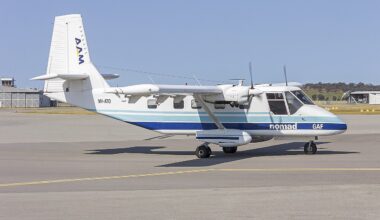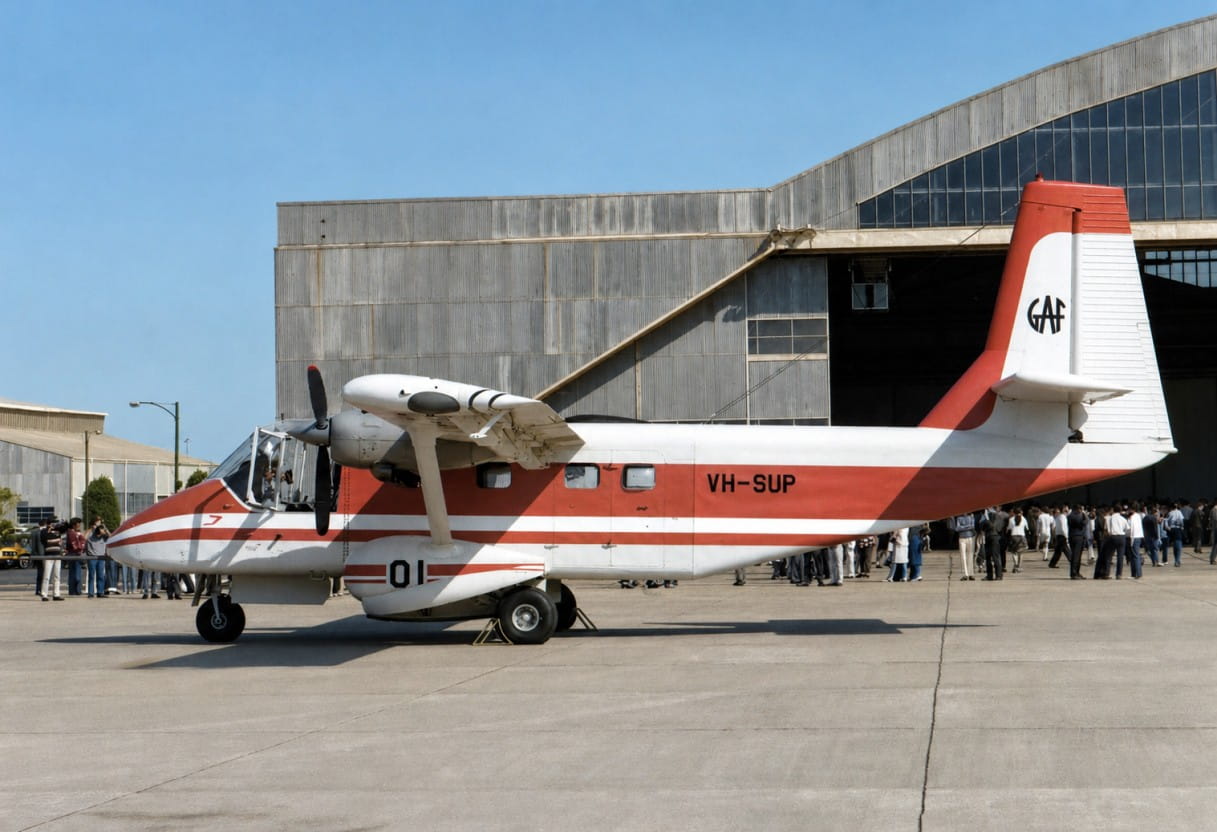
On 6 August 1976 a prototype GAF Nomad VH-SUZ shed control of its tailplane barely a minute and a half after take-off, killing two of the three men on board. The accident had nothing to do with how the aeroplane was flown and everything to do with a small structural modification, and a design rule that no longer applied.
Just after 11.03 on the morning of 6 August 1976, the pilot of Nomad N24-10 reported control difficulty at about 950 feet, moments after lifting off from Avalon aerodrome, near Geelong in Victoria. The aircraft rolled into a descending left turn through roughly 175 degrees and struck the ground. The pilot was killed on impact; the observer in the right-hand seat died of his injuries two days later; and the flight test engineer, seated in the cabin, survived with severe spinal injuries. From the start of the take-off roll to ground impact, the flight had lasted about one minute and thirty-four seconds.
The aircraft and the test programme
N24-10 was owned by the Government Aircraft Factories (GAF) and was the prototype of the N24, a stretched development of the already-certificated Nomad N22. For the accident flight it carried the trade-plate registration VH-SUZ and was flying under a Department of Transport Permit to Fly; as a developmental aircraft it held no Certificate of Airworthiness. With only one airframe available, GAF was using it for two parallel efforts: certification of the standard N24, and development work on a proposed higher-gross-weight N24A that was to offer a 20-degree flap setting for take-off.
It was the N24A work that put the aircraft in the air that day. To improve a marginal stick-force gradient in the 20-degree flap configuration, GAF had progressively modified the tailplane and its trim tabs across a series of flights through May and June 1976, adding and removing trailing-edge T strips, then enlarging the tabs in stages until they ran the full span of the tailplane. The accident flight, the 128th of the programme, was the first to combine full-span tabs with 50 mm T strips along their trailing edges. The purpose was simply to measure the effect of that configuration on longitudinal stability. The aircraft was not to exceed 120 knots equivalent airspeed.
The flight
The crew were experienced. The pilot, Stuart Graham Pearce, 39, was a graduate of the Empire Test Pilot’s School at Farnborough and a former Royal Air Force test pilot, with 4,483 flying hours. The flight test engineer, Philip Patrick Larcey, 36, had twelve years in the role. In the right-hand seat was David Roy Hooper, 47, an aeronautical engineer who was GAF’s Senior Designer Structures and Mechanical and, at the time, acting Chief Designer; he was aboard to observe the effect of the tailplane modifications he was responsible for clearing.
Avalon was reporting a strong, gusty crosswind, around 240 to 270 degrees at 20 to 35 knots, with good visibility. N24-10 took off to the west from one of GAF’s grass STOL strips. As it became airborne the pilot applied a brief series of push-pull inputs to the tailplane, then settled into a normal straight-ahead climb. The flight recorder showed the aircraft accelerating steadily and climbing at a normal rate, reaching 106 knots and 220 feet before the engineer switched the recorder off to conserve paper.
Flutter and loss of control
At about 950 feet, over or just past the runway, three witnesses on the ground saw the trailing edge of the tailplane begin to flutter, one described it as flapping like a rag in a strong wind, and watched a dark object fall away from the aircraft. From the tower the controller saw the Nomad pitch steeply nose-down and asked whether operations were normal; the pilot answered, “negative negative.”
The flight test engineer, who could not see the instruments, recalled a buzzing vibration and a positive nose-down pitch at an estimated 1,000 to 1,200 feet, and the pilot saying he did not think they were going to make it. The engineer released his harness and went for his parachute pack, then heard the pilot say he thought he had regained control as the nose came up. He returned to his seat. The aircraft entered the descending left turn, the vibration coming and going, until at perhaps 100 feet the pilot could no longer hold it and the Nomad sideslipped into the ground, sliding some 70 metres before coming to rest.
The structural evidence was unambiguous. Pieces of the left tailplane, sections of lower skin, part of the root rib, and a 1.47-metre length of T strip, were found close to the runway centreline, well short of the main wreckage, marking the point at which the destruction began. The tailplane and tabs had been torn apart by violent oscillation, with repeated reversals of load collapsing the structure aft of the main spar. No other defect or malfunction was found.
The investigation: why the tailplane failed
A joint group from the Department of Transport, the Aeronautical Research Laboratories and GAF was formed to study the flutter behaviour of the aircraft in its accident configuration. Ground resonance tests, wind-tunnel testing of a tailplane fitted with T strips, and a reworked flutter analysis converged on a clear picture: the modified tailplane was prone to a flutter mode combining antisymmetric torsion of the tailplane with rotation of the tabs.
The calculations put the most likely critical flutter speed at about 103 knots equivalent airspeed, below the aircraft’s normal climbing speed of around 110 knots, and below the 106 knots the recorder had captured only seconds earlier. Worse, the onset would have been almost instantaneous. At the critical speed the oscillation amplitude would double roughly every 0.4 seconds, so the tailplane could go from the first detectable flutter to catastrophic failure within a few seconds. That matched both the witness accounts and the tight grouping of shed wreckage on the ground.
The Broadbent Criterion and its limits
The central question was why a structure thought to be safe to 120 knots had failed at little more than 100. Throughout the modification programme, freedom from flutter at the 120-knot test limit had been checked not with a full flutter analysis, a lengthy undertaking, but with the Broadbent Criterion, a simplified empirical rule long used to clear conventional designs for flight testing. On the knowledge then available, applying it was not unreasonable; the T-strip principle was not a radical departure from accepted practice, and the design team had deep experience of the N22 and N24.
The flaw lay in the aerodynamics. The detailed post-accident testing showed that adding T-strips to the tab trailing edges generated aerodynamic forces substantially greater than conventional theory predicted, large enough to invalidate the Broadbent Criterion as a guide to freedom from flutter. Even the smaller 25 mm strips on the standard tabs, the analysis found, produced a configuration the criterion could no longer safely cover. The official cause was recorded accordingly: the simplified design criterion used to justify freedom from flutter during the tailplane modification testing was not valid for a design that included tab trailing-edge T-strips.
The investigation was equally clear about what was not at fault. The aircraft was properly crewed and maintained, the weather played no part, and a trivial overshoot of the permitted all-up weight (3,862 kg against a 3,855 kg limit) had no bearing on handling. This was an aeroelastic failure, not a loading or piloting one.
A costly loss
The accident cost GAF two senior figures at once: its experienced test pilot and its acting Chief Designer. There is a poignant footnote in the timing. Only weeks earlier, both Pearce and Hooper had attended the investigation into another Nomad loss, the “Double Six” crash of N22B 9M-ATZ at Kota Kinabalu on 6 June 1976, as the manufacturer’s representatives, Pearce listed as Chief Test Pilot and Hooper as Chief Designer. The two men who sat in on the inquiry into one Nomad accident were dead in the next within two months.
A recurring weakness
The Double Six crash had been a loading accident: an aft centre of gravity that left the pilot without enough forward control to arrest a pitch-up. Avalon was something different, a structural failure of the tailplane itself, triggered by a developmental modification. Yet both pointed, from different directions, at the same part of the aeroplane. The Nomad’s empennage would remain its most sensitive structure, and fourteen years later a tailplane would again separate from a Nomad in flight, this time over Edinburgh in South Australia, through fatigue rather than flutter. Avalon stands as the first and most technical chapter in that story: a reminder that a small change to a control surface can carry an aircraft outside the envelope its clearance methods were ever designed to cover.
Primary sources
Department of Transport (Australia), Air Safety Investigation Branch, Special Investigation Report 77-1: Government Aircraft Factories Nomad N24 Aircraft Serial Number 10 at Avalon, Victoria, on 6 August 1976 (Australian Government Publishing Service, Canberra, 1977).
Jabatan Penerbangan Awam Malaysia, Aircraft Accident Report No. 1/76: Nomad N22B 9M-ATZ, Kota Kinabalu, 6 June 1976 (investigation team attendance list).