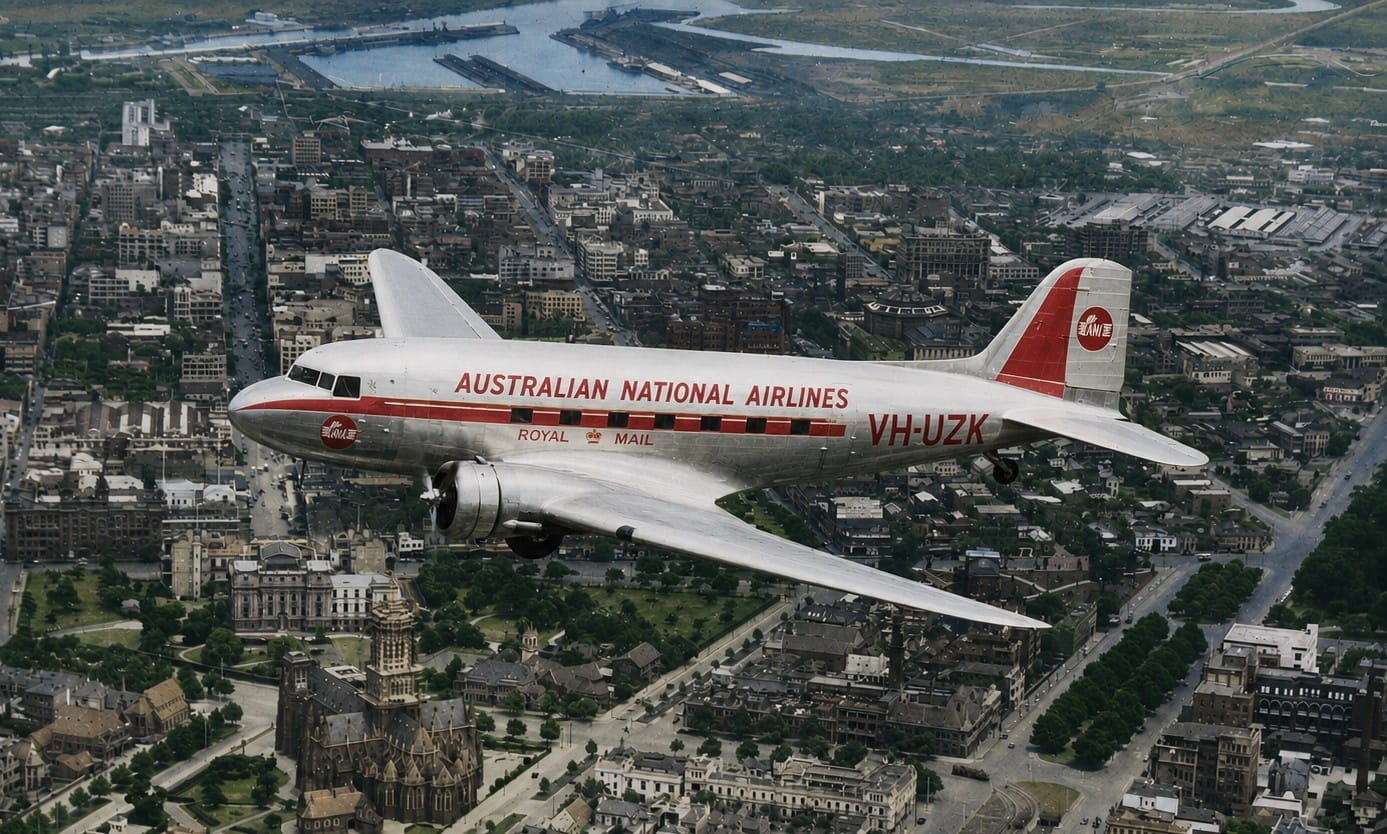
How the Holyman family took their seafaring spirit aloft and built the airline that defined an era of Australian aviation
Long before the first runway was graded at Essendon or the first departure board was chalked at Mascot, the Holymans were already in the business of getting people across the water. For nearly a century, the family name had been synonymous with Tasmanian shipping a dynasty built on Bass Strait, salt air, and stubborn determination. That same spirit, when aviation came calling in the early 1930s, translated almost naturally from the sea to the sky.
The story of the Holymans in Australian aviation is one of the great untold epics of our transport heritage. Rooted in Tasmania, centred on Melbourne, and ultimately shaping the entire structure of the nation’s air industry, the family’s journey from a small Fox Moth aircraft to the chairmanship of a national airline and the dramatic aftermath that followed is as compelling as any in our aviation canon.
A Family Forged by the Sea
The Holyman saga begins with an English mariner, William Holyman, who arrived in Tasmania under circumstances that were, to put it charitably, unconventional. Said to have deserted ship at George Town and spent three months on the treadmill as punishment, he evidently found the island much to his liking. He stayed, settled, and established the William Holyman & Sons shipping company, which would grow across the nineteenth century into one of the most significant transport enterprises in the colony. He had four children and would eventually count thirty-one grandchildren and eighteen great-grandchildren among his descendants a dynasty in every sense.
At its height, the family operated vessels across Bass Strait, delivered mail and freight, and at one point owned multiple islands in the strait itself. The family was not merely in transport they were Transport. The leap to aviation, when it came, was made by two of William’s great-grandsons: Victor Clive Holyman and Ivan Nello Holyman, born in 1894 and 1896 respectively at Devonport, Tasmania, the tenth and eleventh of thirteen children of William Holyman Jr.
Victor Takes to the Air
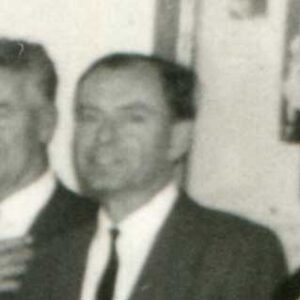
Victor Holyman had served as a ship’s officer in the family firm before the First World War drew him into service with the Royal Naval Air Service, where he trained as a pilot and rose to the rank of Flight Sub-Lieutenant. That wartime experience left its mark. When he returned to Tasmania, the sea no longer held quite the same thrill.
Meanwhile, on Flinders Island in Bass Strait, a rival service had begun operating in early 1932, connecting the island to Launceston by air and cutting directly into the Holyman shipping trade. The family’s response was characteristically direct: if aviation was going to threaten their livelihood, they would simply get into aviation themselves.
At a Glance — The Holyman Aviation Legacy
- 1932 — Holyman Bros Pty Ltd founded; Victor flies a de Havilland Fox Moth named Miss Currie between Launceston and Flinders Island
- 1934 — Holyman’s Airways Pty Ltd registered with capital of £90,000; first DH.86 airliner ordered
- 1934 — Victor Holyman dies when Miss Hobart is lost in Bass Strait, 18 October
- 1936 — Australian National Airways (ANA) formed via merger with Adelaide Airways; Ivan Holyman at the helm
- 1936 — ANA opens its landmark hangar and terminal at Essendon Airport, Melbourne
- 1946 — Government establishes Trans Australia Airlines; Ivan Holyman refuses the General Manager role
- 1957 — Sir Ivan Holyman dies in Honolulu, January
- 1957 — ANA offered to the government; offer declined; Ansett buys ANA for £3.3 million, October
In 1932, the family purchased a three-passenger de Havilland DH.83 Fox Moth, and Victor commenced flights between Launceston and Flinders Island under the banner of Holyman Bros Pty Ltd. The little aircraft was named Miss Currie, after the principal town on nearby King Island a touch of character that would become something of a Holyman trademark. Victor later extended services to connect Launceston with Melbourne, crossing Bass Strait in conditions that would give pause to many modern pilots.
The rival service merged with the Holymans’ operation, and together they began building what would become Tasmania’s and eventually Australia’s most important domestic airline. But the sea had one more dark card to play.
Tragedy Over the Strait
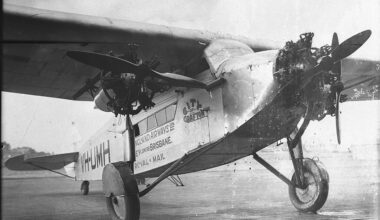
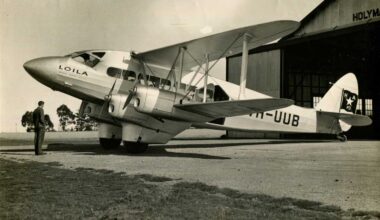
By 1933, the Australian Government had announced the Empire Air Mail Scheme, and the Holymans saw an opportunity to grow into a proper airline. Ivan, who had returned from wartime service with the Military Cross and taken his place in the family business, partnered with two major Tasmanian shipping companies Huddart Parker and the Union Steamship Company of New Zealand to form Holyman’s Airways Pty Ltd. Registered in July 1934 with a capital of £90,000, the new company ordered two de Havilland DH.86 Express airliners.
The first of these, VH-URN Miss Hobart, entered service on 28 September 1934. Three weeks later, on 18 October, she vanished over Bass Strait. Captain Victor Holyman was among the eleven lives lost, his remains never recovered. Wreckage was sighted from the air during a search three days later, but no survivors were found.
“Formidable characters” so remembered by a descendant of their great rival, Laurie Johnson. It was a fitting tribute to a family that buried its pioneer and kept flying.
It would have ended lesser enterprises. But the Holymans were, as one observer later recalled, formidable characters. Ivan did not fold. He pressed on, purchasing additional aircraft and continuing to expand the network. Within two years, the airline had grown to the point where a larger corporate structure was required.
Australian National Airways an Empire in the Air
In 1936, Holyman’s Airways merged with Adelaide Airways to form Australian National Airways Pty Ltd (ANA), adopting the name and registration that had briefly been held by Charles Kingsford Smith’s ill-fated airline earlier in the decade. Ivan Holyman became managing director, and he proved every bit as ambitious in the air as his family had been on the water.
Melbourne became the operational heart of ANA, and the family’s presence in Victoria was made concrete and permanent when Ivan commissioned architect Howard Garnet Alsop to design Australia’s largest hangar at Essendon Airport. The building now known as ANA House, at 230 Wirraway Road, Essendon Fields opened in 1936 and stood as the primary ANA terminal and hangar in the country. A lane on its southern side was later named Holyman Lane in the family’s honour.
The airline’s Melbourne connection was further cemented by the iconic Holyman House on Flinders Street in the CBD a heritage-listed building that served as ANA’s Melbourne headquarters throughout the airline’s life.
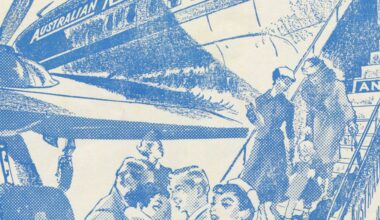
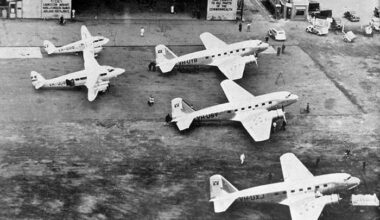
Under Ivan’s leadership, ANA grew to become Australia’s dominant domestic carrier, linking Brisbane, Sydney, Melbourne, Adelaide, and Tasmania on regular scheduled services. The airline introduced innovations that seem obvious in retrospect but were genuinely revolutionary at the time: air hostesses (the first in Australia, trained in 1936 by Hazel Holyman, Victor’s widow), free in-flight meals, and automatic passenger insurance. By 1942, ANA had absorbed Airlines of Australia and New England Airways, and the Holyman empire was at its peak.
Ivan also attempted ,unsuccessfully, to expand into international routes, but found the Commonwealth Government’s hold on overseas air travel through Qantas impossible to break. An exception came briefly between 1946 and 1948, when ANA operated flights for the part-government-owned British Commonwealth Pacific Airlines before that organisation acquired its own aircraft. ANA did also try to absorb Ansett Airways in the late 1940s, but a certain Reginald Ansett declined rather emphatically and expanded his own operation instead. That decision would have profound consequences a decade later.
The Government Comes Calling and Ivan Declines
The post-war years brought a new political reality to Australian aviation. The Chifley Labor government had long harboured ambitions for a government-owned domestic airline, and in 1945 it established the Australian National Airlines Commission (ANAC) to create exactly that. The new airline which the Commission named Trans Australia Airlines would need experienced leadership.
Both Ivan Holyman and Reginald Ansett were approached. Ansett offered to sell his entire operation to the ANAC as a going concern; the Commission found his asking price optimistic and talks ended. Ivan Holyman’s situation was altogether more interesting. There was considerable correspondence between the Commission and Holyman, exploring the possibility of recruiting him as General Manager of TAA at the then-princely salary of £10,000 per annum and when that overture was declined, of buying ANA outright.
Ivan Holyman was not a man to work for a government body, nor to sell the airline he had built. He was, however, open to the idea of a “composite company” some form of public-private hybrid. The details of this proposal remained unclear and ultimately unresolved. The Commission eventually proceeded with its original plan: to build TAA from scratch. The first General Manager they hired Lester Brain, poached from Qantas received a salary of £3,000 per annum. The £10,000 that had been offered to Holyman went, in the end, to no one.
TAA commenced operations in September 1946. The stage was set for the “Two Airline Policy” era a period of carefully managed competition between the government-owned TAA and the privately held ANA that would define Australian domestic aviation for the next decade. Ivan Holyman was knighted in 1951 in recognition of his contribution to the industry.
The Slow Decline and a Final Reckoning
The two-airline era was harder on ANA than the tidy phrase implies. TAA, backed by the Commonwealth purse, was able to absorb losses and invest in new equipment in ways that placed ANA under constant pressure. The tension reached an absurdity in 1955 when the government ostensibly in the name of “equipment parity” legislated that TAA exchange its three modern turbo-prop Vickers Viscount aircraft for two of ANA’s older, slower Douglas DC-6Bs, then directed TAA to purchase a third DC-6B to maintain seat parity. TAA’s objections were noted and ignored; the government held the purse strings.
The Viscount was faster, quieter, and overwhelmingly preferred by passengers. The forced equipment exchange was a significant blow to TAA, but ANA’s broader financial difficulties were mounting regardless. The airline was receiving government subsidies while TAA was returning a profit a structural imbalance that could not be resolved so long as ANA’s shareholders were unwilling to inject additional capital.
Then, on the night of 18–19 January 1957, Sir Ivan Nello Holyman died in his sleep while holidaying in Honolulu. He was only sixty years old. The man who had kept the airline flying through personal tragedy, government competition, and decades of commercial pressure was gone. He was cremated in Hawaii; his wife, daughter, and two sons survived him.
Without Ivan, the ANA board’s appetite for the fight evaporated. The shareholders which included the major shipping companies made the logical commercial decision. They offered to sell the airline to the government, proposing a merger of ANA with TAA and the smaller regional carriers. It was, in its way, the deal that Ivan had been approached about a decade earlier, only now it was ANA that was doing the asking.
The government said no.
The reasons were partly political a merger would have created an effective domestic monopoly and partly practical. The government instead quietly pointed Reginald Ansett toward the opportunity. His initial bid of £3,000,000 was rejected, but with additional assistance from Shell Oil Company, a second and final bid was put forward. The shipping company shareholders, who had never been especially enthusiastic about the airline business, accepted it with what contemporary accounts describe as reluctant relief.
On 3 October 1957 less than nine months after Ivan’s death Australian National Airways was sold to Ansett Transport Industries for £3.3 million. The airline was rebranded Ansett-ANA, and the Holyman name quietly left the sky. In 1961, the approach road to Hobart Airport was named Holyman Drive a quiet farewell from the island that had given the family its start.
The Legacy: Melbourne, Victoria, and the Shape of Australian Aviation
It would be a mistake to think of the Holymans as merely a Tasmanian story. By the time ANA reached its height, the airline was thoroughly Victorian in its operations. Essendon Airport was the nerve centre the hangar Ivan commissioned there was the largest aviation building in Australia when it was completed, and it remained the company’s primary operational base throughout its existence. The Melbourne CBD headquarters at Holyman House on Flinders Street was where the boardroom decisions were made. The routes that ANA dominated Sydney to Melbourne, Melbourne to Adelaide, Melbourne to Brisbane were the arterial routes of the young nation’s aviation network.
The innovations ANA introduced under Ivan Holyman’s leadership became the baseline expectations of Australian passengers: that there would be someone to look after you in the cabin, that a meal would be served, that your family would be compensated if the worst happened. These were not minor conveniences. They were the civilising of commercial flight.
Ivan also understood, as early as the 1930s, that aviation was not merely a transport business but a national infrastructure. His resistance to being absorbed into TAA was not simple stubbornness it was a coherent view that private enterprise and competitive pressure produced better outcomes for passengers. History is ambivalent on whether he was right; what is not ambiguous is the scale of what he built.
Holyman Landmarks You Can Still Find
- ANA House, Essendon Fields — 230 Wirraway Road. The iconic 1936 hangar and terminal Ivan Holyman commissioned, now home to various tenants. Holyman Lane runs along its southern side.
- Holyman House, Melbourne CBD — Flinders Street at Market Street. A heritage-listed building that served as ANA’s Melbourne headquarters from 1936 to 1957.
- Holyman House, Launceston — 52–60 Brisbane Street. The striking Art Deco building completed in 1936–37, headquarters of both William Holyman & Sons and ANA. Now on the Tasmanian Heritage Register.
- Holyman Drive, Hobart Airport — Named in 1961 in memory of Sir Ivan Holyman and the family’s contribution to Tasmanian aviation.
The last vessel privately owned by the Holyman family the Mary Holyman stopped trading in 1987, bringing a quiet close to 130-odd years of Holyman transport enterprise. Robin Holyman, the last family member to work in the transport company before it was sold, has spoken of the airline as part of his earliest memories something “partly forgotten to time” but forming a significant part of what Australia became.
He is right. The Holyman family gave Australia its first air hostesses, its first major interstate airline, and a blueprint for what commercial aviation could look like when run with ambition and care. They did it from the unlikely launchpad of a small Tasmanian island in Bass Strait, with a three-seat Fox Moth and a family name that had already meant something on the water for nearly a century.
They took all of that the seamanship, the commercial instinct, the stubborn insistence on getting across and pointed it at the sky. For twenty-five years, Australian National Airways was the sky. The fact that we have largely forgotten them is our loss, not theirs.
1932
Victor and Ivan Holyman launch Holyman Bros Pty Ltd, flying a Fox Moth named Miss Currie between Launceston and Flinders Island.
1934
Victor Holyman dies when Miss Hobart vanishes over Bass Strait. Ivan restructures into Holyman’s Airways Pty Ltd and presses on.
1936
Merger with Adelaide Airways creates Australian National Airways. ANA’s Essendon hangar opens as Australia’s largest aviation building. Air hostesses introduced the first in Australia.
1942
ANA absorbs Airlines of Australia and New England Airways, becoming the dominant domestic carrier on all major Australian interstate routes.
1946
The Chifley Government establishes TAA. Ivan Holyman declines the role of General Manager at £10,000 per annum and refuses to sell ANA outright.
1951
Ivan Holyman is knighted for his services to Australian aviation.
January 1957
Sir Ivan Holyman dies in Honolulu. The ANA board offers the airline to the government; the government declines.
October 1957
ANA sold to Ansett Transport Industries for £3.3 million. The Holyman era of Australian aviation ends. Ansett-ANA carries the legacy forward.
Written for FlyingTin.com — celebrating Australian aviation history and heritage.
Sources include the Australian Dictionary of Biography, the Tasmanian Companion to History, the TAA Museum archives, and contemporaneous records held at the University of Melbourne Archives and the Tasmanian Heritage Register.