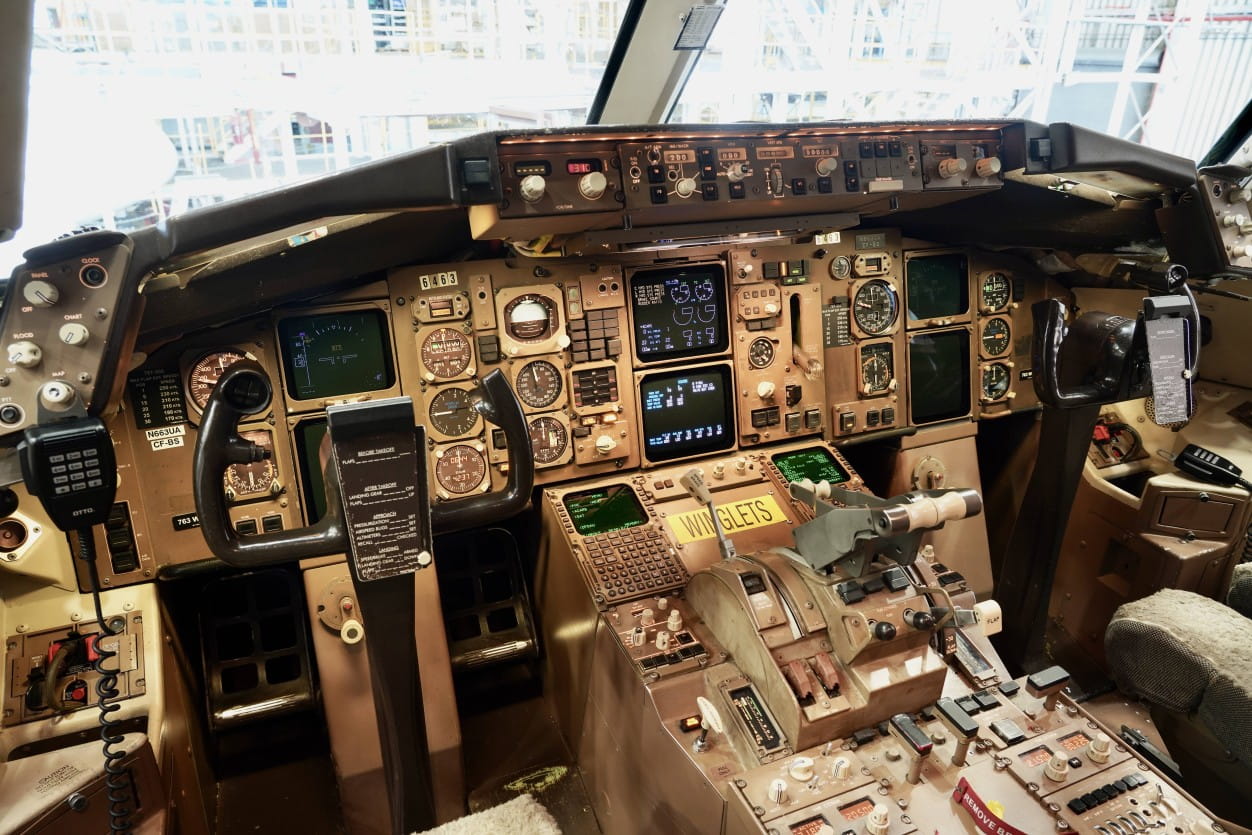
How the 767 Revolutionized the Modern Glass Cockpit
When the Boeing 767 entered service in 1982, it represented far more than just another new wide-body aircraft. The 767 introduced a revolutionary flight deck design that helped transform commercial aviation from the analog cockpit era into the digital age.
For the first time in a major commercial airliner, traditional mechanical flight instruments were largely replaced by computer-driven electronic displays. Combined with digital avionics and advanced system monitoring, the Boeing 767 became widely regarded as the first truly digital airliner.
The aircraft not only reshaped cockpit technology but also influenced nearly every modern aircraft that followed.
The Problem with Traditional Cockpits
Prior to the 1980s, airline cockpits were dominated by electromechanical instruments.
A typical flight deck included dozens of gauges displaying:
- airspeed
- altitude
- attitude
- vertical speed
- navigation information
- engine parameters
Each instrument operated independently and relied on mechanical components, sensors, and complex wiring.
The result was:
- crowded instrument panels
- high maintenance requirements
- limited integration between systems
As aircraft systems became more complex, the traditional cockpit architecture began reaching its limits.
Boeing’s Next Generation Airliner
In the late 1970s Boeing began developing two new aircraft simultaneously:
- the Boeing 757 (narrow-body)
- the Boeing 767 (wide-body)
A key design goal for both aircraft was a fully modernized flight deck built around electronic displays and digital avionics.
This required new display technology and new computer systems capable of integrating aircraft data in ways never previously possible.
Collins and the Development of EFIS
A major contributor to this transformation was the Collins Air Transport Division, which developed the Electronic Flight Instrument System (EFIS) used on the 757 and 767.
Instead of traditional round gauges, flight information was displayed on full-color CRT screens using shadow-mask display technology.
These displays were ruggedized to withstand:
- aircraft vibration
- temperature variation
- cockpit lighting conditions
The result was a new generation of flight displays that could present complex information in a clear and easily interpreted format.
The Primary Flight Display
The most important innovation was the Primary Flight Display (PFD).
Rather than separate instruments for attitude, airspeed, altitude, and vertical speed, the PFD combined these into a single integrated display.
Pilots could see all essential flight data in one location, dramatically improving situational awareness.
Key PFD elements included:
- attitude indicator
- airspeed tape
- altitude tape
- vertical speed indicator
- flight director guidance
This layout quickly became the standard for modern airliners.
The Navigation Display
Alongside the PFD, the 767 introduced the Navigation Display (ND).
This screen provided pilots with a graphical overview of the aircraft’s flight path and surrounding environment.
The navigation display could show:
- flight management routes
- navigation beacons
- weather radar returns
- waypoint information
For the first time, pilots could see their entire route and navigation environment visually, rather than interpreting raw data from multiple instruments.
The Introduction of EICAS
Another revolutionary system introduced on the Boeing 767 was the Engine Indication and Crew Alerting System (EICAS).
Traditionally, aircraft engine monitoring involved dozens of individual gauges.
EICAS replaced these with centralized digital engine displays.
The system monitored engine performance and aircraft systems automatically, alerting the crew if any parameter moved outside safe limits.
EICAS also introduced a new concept: automated system alerts.
Warnings and advisories were prioritised and presented directly to the crew, reducing the need for continuous manual monitoring. However, historical data shows that the Flight Engineer’s mechanical instruments were highly reliable, often achieving a mean time between failures (MTBF) of around 100,000 hours.
The primary cost saving ultimately came from eliminating the Flight Engineer’s salary, although a significant portion of those savings was offset by the cost of display systems supplied by manufacturers such as Collins.
The First Fully Digital Airliner
Beyond the displays themselves, the Boeing 767 was built around digital avionics architecture.
Earlier aircraft relied heavily on analog electronics.
The 767 instead used digital computers and data buses to manage navigation, flight guidance, and aircraft systems.
This architecture allowed different avionics systems to communicate efficiently and share information across the cockpit.
The result was a level of integration that had never previously existed in commercial aviation.
Two Pilots Instead of Three
Another major impact of the 767’s digital systems was the elimination of the flight engineer position.
Older aircraft such as the:
- Boeing 727
- Boeing 747
- DC-10
required a third crew member to monitor engine instruments and aircraft systems. Because EICAS automated much of this monitoring, the Boeing 767 could safely operate with only two pilots.
This significantly reduced airline operating costs and quickly became the standard configuration for future airliners. Nevertheless, the early CRT displays themselves were costly and had limited service lives, often developing screen burn-in or image imprinting after several years of operation.
Influence on Future Aircraft
The success of the Boeing 767 flight deck influenced nearly every aircraft that followed.
The design philosophy established by the 767 can be seen in:
- Airbus A320 family
- Boeing 777
- Boeing 787
- Airbus A350
All modern airliners use variations of the EFIS and EICAS concepts first introduced on the 767.
The Bridge Between Analog and Digital Aviation
The Boeing 767 occupies a unique place in aviation history.
It served as a bridge between two eras:
The analog cockpit era
- mechanical instruments
- manual monitoring
- complex instrument panels
The digital cockpit era
- integrated displays
- automated monitoring
- computer-driven avionics
By successfully introducing these technologies into airline service, the 767 demonstrated that digital cockpits could improve both safety and efficiency.
The 767 and 757 were so digital that instruments, such as the MASI and RDMI, were fed by a 429 bus and then converted back to analog signals to drive stepper motors and gears. The thinking at the time was that if there was an accident, some mechanical indicators were needed to show the frozen needle positions, something that all electronic displays could not do in he 1980’s.
The Lasting Legacy of the 767 Flight Deck
More than four decades after its introduction, the Boeing 767 continues to operate worldwide in both passenger and cargo roles.
But perhaps its most important legacy is the flight deck architecture it introduced.
Today’s modern airliners filled with high-resolution LCD displays and advanced avionics can trace their design directly back to the pioneering cockpit of the Boeing 767.
It was the aircraft that proved the glass cockpit could work, and in doing so, helped define the modern age of aviation.