Two Super-Midsize Business Jets That Redefined Corporate Aviation
During the 1990s and early 2000s, the market for super-midsize business jets expanded rapidly. Corporate operators were seeking aircraft capable of transcontinental and intercontinental travel, while still maintaining the efficiency and operating costs of smaller jets. Two aircraft that emerged as major competitors in this category were the Dassault Falcon 2000 and the Gulfstream G200.
Both aircraft offered impressive range, large cabins, and advanced avionics. Yet they were developed from very different engineering philosophies and corporate backgrounds.
The Dassault Falcon 2000
French Engineering with Wide-Body Comfort
The Dassault Falcon 2000 was introduced in the mid-1990s as a twin-engine development of the successful Falcon 900 trijet.
The aircraft first flew in 1993 and entered service in 1995.
Dassault designed the Falcon 2000 to provide the cabin comfort of a wide-body business jet while improving fuel efficiency through the use of two engines rather than three.
Key specifications
- Engines: Two CFE738 turbofans
- Cruise speed: Mach 0.80
- Range: approximately 3,000–3,350 nautical miles
- Typical passengers: 8–10
- Cabin width: 7 ft 8 in (2.34 m)
The aircraft retained many features from earlier Falcon designs, including a highly efficient swept wing and exceptional aerodynamic performance.
Falcon Handling and Efficiency
One of the defining characteristics of the Falcon 2000 is its aerodynamic efficiency.
Dassault aircraft have long been known for:
- excellent high-altitude performance
- efficient cruise speeds
- strong short-field capability
These characteristics allowed the Falcon 2000 to operate from smaller airports while maintaining impressive range.
Later variants, including the Falcon 2000EX and Falcon 2000LX, significantly extended range and improved fuel efficiency through upgraded engines and winglets.
The Gulfstream G200
A Transcontinental Business Jet with Israeli Roots
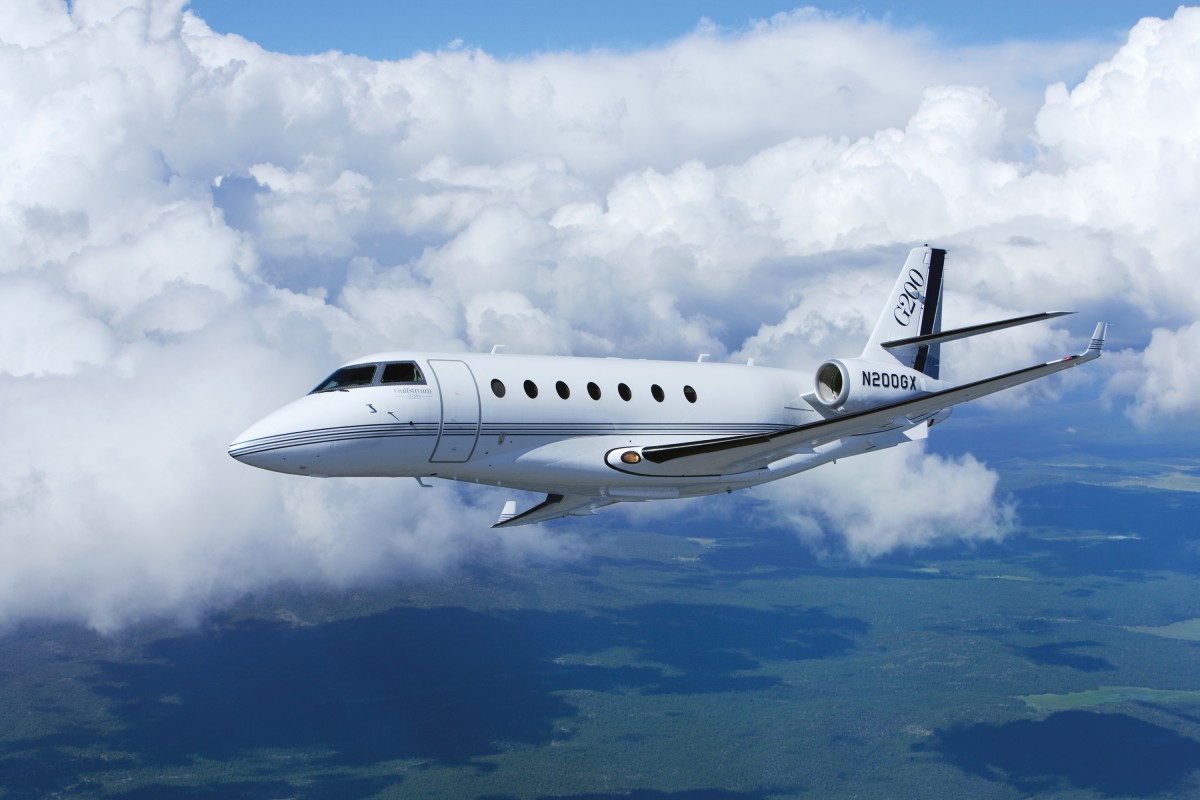
The Gulfstream G200 has a very different origin story.
The aircraft was originally developed in Israel by Israel Aircraft Industries (IAI) as the IAI Galaxy during the early 1990s.
The aircraft first flew in 1997.
When Gulfstream Aerospace acquired the marketing rights to the aircraft in 2001, it was renamed the Gulfstream G200 and became part of the Gulfstream product line.
Key specifications
- Engines: Two Pratt & Whitney PW306A turbofans
- Cruise speed: Mach 0.80–0.82
- Range: approximately 3,400 nautical miles
- Typical passengers: 8–10
- Cabin height: 6 ft 3 in (1.91 m)
The aircraft offered one of the largest cabins in the super-midsize class, making it particularly attractive for corporate operators seeking space and comfort.
Cabin and Passenger Experience
Both aircraft provided spacious cabins compared with earlier midsize business jets.
Falcon 2000
The Falcon’s fuselage was derived from the Falcon 900 design, giving it a wide, comfortable cabin with excellent noise levels.
Typical configurations include:
- club seating
- conference table
- galley
- private lavatory
Gulfstream G200
The G200 offered a longer cabin, providing additional seating flexibility and passenger comfort.
Many corporate operators valued the G200 for:
- large baggage capacity
- spacious seating arrangements
- strong transcontinental performance
Avionics and Flight Deck
Both aircraft introduced modern digital avionics systems typical of high-end business jets of the 1990s.
Falcon 2000
The Falcon 2000 featured the Collins Pro Line 4 avionics suite, including:
- large 7×7 inch CRT flight displays
- integrated flight management systems
- digital autopilot and navigation systems
The system provided excellent situational awareness and reliability for long-range business operations.
Gulfstream G200
The G200 also used the Collins Pro Line 4 avionics system, making the cockpit architecture of both aircraft remarkably similar.
Key features included:
- Electronic Flight Instrument System (EFIS)
- Flight Management System (FMS)
- digital engine monitoring systems
For pilots transitioning between aircraft types, the Pro Line avionics family provided familiar operating logic and display formats. Thomas Global Systems has stepped forward to extend the life of Pro Line 4 flight decks. CRJ Series Operators with the TFD-4000 LCD solution can seamlessly continue operating their current Pro Line 4 configuration, with improved reliability and efficiency, and without impacting flight crew operations.
Performance Comparison
| Feature | Falcon 2000 | Gulfstream G200 |
|---|---|---|
| First flight | 1993 | 1997 |
| Entry into service | 1995 | 1999 |
| Engines | 2 × CFE738 | 2 × PW306A |
| Cruise speed | Mach 0.80 | Mach 0.80–0.82 |
| Range | ~3,000–3,350 nm | ~3,400 nm |
| Passengers | 8–10 | 8–10 |
| Avionics | Collins Pro Line 4 | Collins Pro Line 4 |
While performance between the aircraft is broadly similar, the Falcon 2000 is often praised for its aerodynamic efficiency, while the G200 is known for its large cabin volume.
Operating Philosophy
The two aircraft reflect the different design cultures of their manufacturers.
Dassault Aviation
Dassault aircraft traditionally emphasize:
- aerodynamic efficiency
- high-altitude performance
- excellent short-field capability
This makes Falcon aircraft particularly attractive for operators flying into shorter or more challenging runways.
Gulfstream
Gulfstream aircraft typically focus on:
- cabin comfort
- high-speed cruise
- long-range performance
The G200 fits well into Gulfstream’s broader product line as a smaller companion to the larger Gulfstream GIV and G550 aircraft.
Success in the Super-Midsize Market
Both aircraft achieved strong commercial success.
The Falcon 2000 family has continued evolving through multiple upgraded versions, including:
- Falcon 2000EX
- Falcon 2000LX
- Falcon 2000LXS
The Gulfstream G200 remained in production until 2011, when it was replaced by the more advanced Gulfstream G280, which introduced new engines and avionics.
Legacy of Two Super-Midsize Competitors
The Falcon 2000 and Gulfstream G200 represent an important stage in the evolution of modern corporate aviation.
Both aircraft delivered:
- intercontinental range
- spacious executive cabins
- advanced digital avionics
They helped define the super-midsize business jet category, bridging the gap between smaller corporate jets and large intercontinental aircraft.
Today, many examples of both aircraft remain in service, continuing to support corporate and private aviation operations worldwide.