The Dash 8 Crash That Raised Questions About GPWS Warning Time
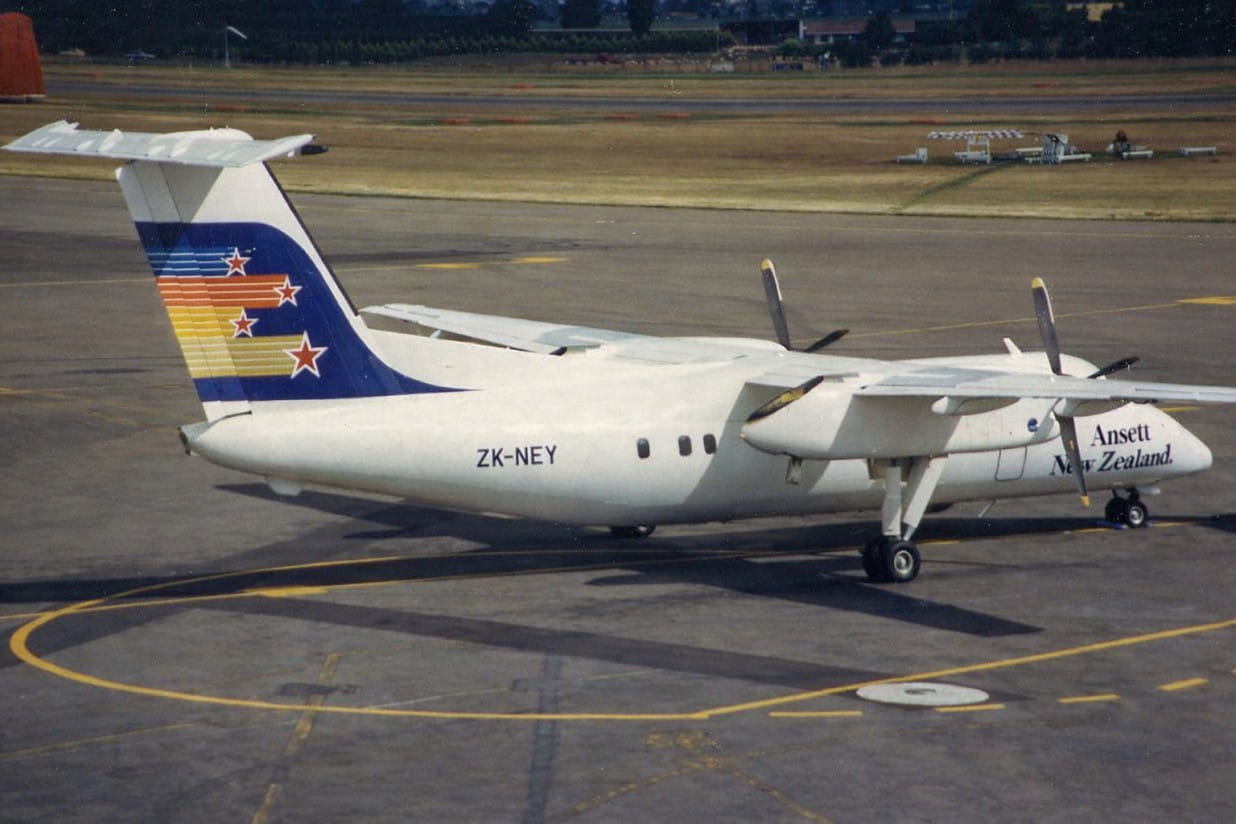
On 5 June 1995, Ansett New Zealand Flight 703 departed Auckland for a routine domestic flight to Palmerston North. The aircraft was a de Havilland DHC-8 Dash 8, carrying 21 people: 18 passengers and 3 crew.
The flight should have been uneventful.
Instead, it became one of New Zealand’s most significant commuter-airline accidents—an accident that highlighted the dangers of crew distraction during approach, and later raised serious questions about the performance of the aircraft’s Ground Proximity Warning System (GPWS).
The crash killed four people and injured everyone else on board.
A Routine Approach Turns Into an Emergency
As Flight 703 approached Palmerston North, the crew began preparing for landing.
During the approach, the aircraft’s landing gear failed to lower hydraulically. The pilots were forced to use the manual extension procedure to get the undercarriage down.
While the crew concentrated on troubleshooting the landing gear problem, the aircraft continued flying toward the hilly terrain near the airport.
This was a classic cockpit trap.
The technical problem demanded attention, but at the same time the aircraft still had to be flown accurately on approach.
The crew’s focus on the undercarriage malfunction came at exactly the wrong moment.
The Crash
The Dash 8 was conducting a non-precision instrument approach into Palmerston North when it descended into terrain.
The aircraft’s GPWS warning sounded only four seconds before impact.
That was not enough time.
The aircraft struck the ground, killing one crew member and three passengers, while all other occupants were injured.
What the Investigation Found
New Zealand’s Transport Accident Investigation Commission investigated the accident and identified several key causal factors.
According to the Commission, the main problems included:
- the captain failed to ensure the aircraft intercepted and maintained the correct approach profile
- the captain continued trying to lower the landing gear instead of abandoning the approach
- the captain became distracted from the primary task of flying the aircraft safely
- the first officer did not carry out the Quick Reference Handbook procedure in the correct sequence
- the GPWS warning was too short to allow recovery
In simple terms, the crew became absorbed in solving the landing gear problem while the aircraft drifted below a safe approach path toward rising terrain.
The GPWS Controversy
One of the most important aspects of the investigation concerned the aircraft’s Ground Proximity Warning System.
The GPWS was manufactured by Sundstrand, while the radio altimeter feeding the system had been manufactured by Honeywell.
After the accident, investigators carried out factory simulations and found that the GPWS should have provided at least 12 additional seconds of warning.
That was a major finding.
The investigation determined that:
- the GPWS had been properly maintained by Ansett
- the recovered radio altimeter was operating normally
- the warning given in the accident was insufficient for the aircraft to escape the situation
However, investigators could not conclusively determine why the warning had come so late.
The most likely explanation, according to the Commission, was a possible loss of radio altimeter tracking.
Because the GPWS and radio altimeter had been manufactured in North America, the issue was referred to Canadian authorities and then to the U.S. Federal Aviation Administration, which conducted further examination of the components in the United States.
A Crash at the Border Between Human Error and System Performance
Ansett Flight 703 is remembered because it sits at the intersection of two major aviation safety themes.
The first was human factors.
The crew allowed a secondary technical problem—the landing gear malfunction—to distract them from the essential task of flying a stable instrument approach.
The second was warning-system performance.
Even though the aircraft carried GPWS, the warning came so late that it could not prevent the crash.
That raised difficult questions.
If the warning system had worked as expected, could the aircraft have been saved?
The investigation strongly suggested that the answer may have been yes.
The Legal Aftermath
The crash also led to a significant legal battle involving the aircraft and equipment manufacturers.
Because the GPWS had been built by Sundstrand and the radio altimeter by Honeywell, passengers and families pursued legal action in the United States against the manufacturers, alleging negligence and product liability.
However, the case became entangled in New Zealand’s unique Accident Compensation system, a no-fault national scheme that generally prevents civil claims for personal injury damages and replaces them with compensation through a state-run program.
Although plaintiffs had received compensation in New Zealand, they sought larger damages in the United States.
Ultimately, the U.S. courts ruled that New Zealand was the more appropriate forum, and the case was dismissed on forum non conveniens grounds.
Why Flight 703 Still Matters
Ansett Flight 703 remains an important aviation accident because it highlighted several enduring lessons:
1. Aviate first
No matter what technical fault occurs, pilots must continue to prioritise flying the aircraft safely.
2. Non-precision approaches demand discipline
Without the vertical guidance of an ILS, strict altitude monitoring becomes even more important.
3. Warning systems are only as good as their timing
A terrain alert that comes too late may be operationally useless, even if it technically functions.
4. Human factors and equipment performance can combine
Many accidents are not caused by a single failure, but by several issues interacting at the same time.
Conclusion
The crash of Ansett New Zealand Flight 703 was not caused by a single mistake or a single system failure.
It resulted from a chain of events:
- a landing gear malfunction
- cockpit distraction
- a flawed approach profile
- terrain ahead
- and a GPWS warning that came too late to help
In that sense, Flight 703 became both a human factors accident and a technology performance case study.
It remains a sobering reminder that in aviation, even a routine commuter flight can turn deadly when workload, terrain, and timing come together in the worst possible way.
Photo By Christopher Redford on Flickr