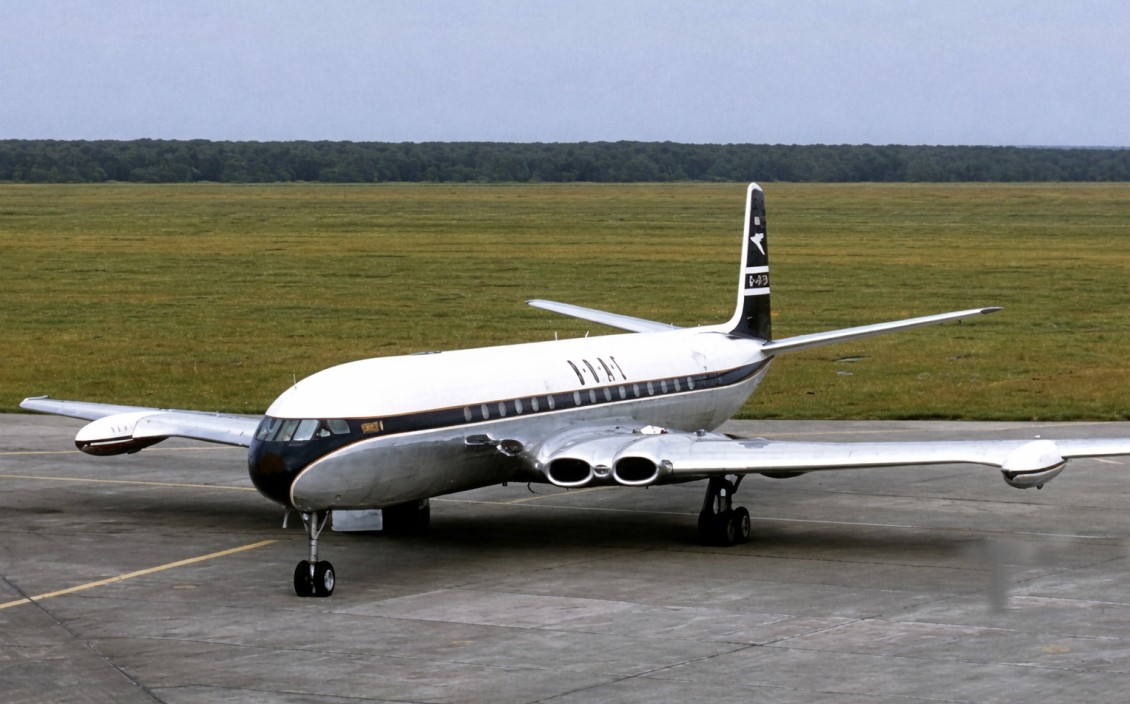
In the early 1950s the de Havilland Comet represented the future of air travel. It was the world’s first jet-powered airliner, capable of flying higher, faster, and smoother than any piston aircraft that had come before.
But within two years of entering service, two catastrophic accidents would ground the entire fleet and fundamentally change aircraft design forever.
The investigation that followed uncovered a danger that aviation had never fully understood before: metal fatigue in pressurised aircraft structures.
The World’s First Jet Airliner
The Comet program began shortly after World War II when de Havilland engineers decided to leap beyond conventional propeller aircraft and build a revolutionary jet airliner. Design work started in 1946 and the first prototype flew in July 1949.
Powered by four de Havilland Ghost turbojet engines buried inside the wings, the Comet cruised at over 35,000 feet, far above the altitude of existing airliners.
Passengers enjoyed:
- Smooth jet-powered flight
- Reduced vibration and noise
- Much faster long-distance travel
When BOAC introduced the Comet to commercial service in May 1952, it instantly became the most advanced passenger aircraft in the world.
Disaster Over the Mediterranean
On 10 January 1954, BOAC Comet G-ALYP departed Rome for London.
About twenty minutes after takeoff, while climbing through approximately 27,000 feet, radio contact abruptly ceased. Witnesses on the island of Elba later reported seeing burning debris falling from the sky.
All 35 people onboard were killed.
At first the cause of the disaster was unknown. The Comet fleet was temporarily grounded, but after initial inspections flights resumed.
Three months later another Comet, G-ALYY, exploded over the Mediterranean near Naples.
The jet age had suffered its first major crisis.
A Groundbreaking Investigation
The British government launched one of the most detailed accident investigations in aviation history.
Fragments of the wreckage were painstakingly recovered from the sea and reconstructed at the Royal Aircraft Establishment (RAE) at Farnborough.
Engineers then conducted a revolutionary experiment.
They placed a complete Comet fuselage inside a giant water tank and repeatedly pressurised it to simulate thousands of flights.
Eventually the structure failed.
The Hidden Enemy: Metal Fatigue
The tests revealed that the aircraft’s pressurised fuselage was slowly developing microscopic cracks.
These cracks formed at the corners of the aircraft’s square windows, where stress concentrations were highest.
Each flight caused the cabin to expand and contract slightly as it was pressurised and depressurised. Over time this cyclic loading caused cracks to grow in the aluminium skin.
Research tests showed that:
- Once visible, most of the fatigue life had already been consumed.
- A crack only a few inches long could rapidly propagate into a catastrophic structural failure.
Eventually a crack grew large enough for the pressurised fuselage to tear apart in flight.
Lessons That Changed Aviation
The Comet disasters forced engineers to rethink aircraft design.
Several major changes followed:
1. Rounded Windows
Square windows created stress concentrations. All future airliners adopted rounded windows to distribute structural loads more evenly.
2. Fatigue Testing
Aircraft would now undergo extensive full-scale fatigue testing to simulate many thousands of flight cycles before entering service.
3. Improved Structural Inspection
Engineers developed new inspection techniques to detect fatigue cracks before they became dangerous.
The Return of the Comet
After extensive redesign, the improved Comet 4 entered service in 1958.
The redesigned aircraft incorporated:
- stronger fuselage structure
- rounded windows
- thicker skin panels
- improved manufacturing techniques
Although the Comet never regained its early commercial lead Boeing’s 707 and the Douglas DC-8 soon dominated the jet age it played a critical role in advancing aviation safety.
A Tragedy That Made Flying Safer
Today, every pressurised aircraft from regional jets to wide-body airliners benefits from the lessons learned from the Comet.
The disasters revealed that metal fatigue could silently destroy even the most advanced aircraft, but they also led to engineering practices that have made modern aviation extraordinarily safe.
The Comet may have suffered a tragic beginning, but its legacy ultimately shaped the safety standards of the entire jet age.