The Forgotten Navigation System That Guided Aircraft for 80 Years
For much of aviation history, pilots flying an Instrument Landing System (ILS) approach expected to hear a distinctive series of tones as they descended toward the runway.
A slow Morse-like tone, followed by a rapid beeping, and sometimes a high-pitched tone.
At the same time, colored lights illuminated on the instrument panel:
- Blue
- Amber
- White
These signals came from the ILS marker beacon system, a technology that helped guide aircraft safely to the runway for decades.
Today, however, marker beacons are quietly disappearing from airports around the world.
To understand why, it helps to look at how the system worked—and why it became so important in early instrument aviation.
The Original ILS Position Fix
The Instrument Landing System was developed during the 1930s and 1940s to allow aircraft to land safely in poor visibility.
ILS provided two critical guidance signals:
Localizer
Guides the aircraft left or right toward the runway centreline.
Glideslope
Guides the aircraft vertically down the correct descent path.
But early systems had one major limitation.
Pilots needed a reliable way to know where they were along the approach path.
This is where marker beacons came in.
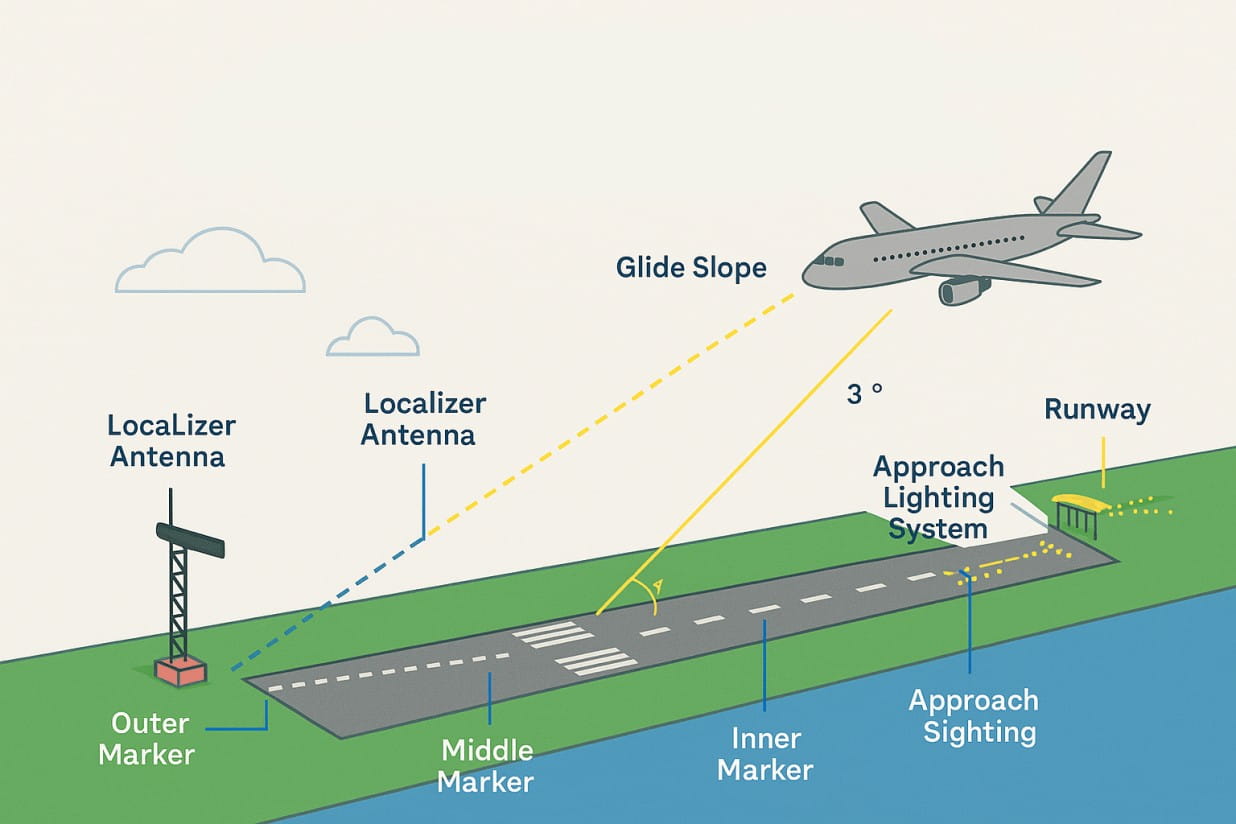
Marker transmitters placed along the runway approach path sent a narrow vertical radio beam upward into the sky. When an aircraft flew through the beam, the cockpit receiver triggered a light and audio tone.
This gave pilots a precise reference point during the approach.
The Three Marker Beacons
Traditional ILS systems used three types of marker beacons.
Outer Marker
The Outer Marker (OM) is located approximately 4–7 nautical miles from the runway threshold, usually near the point where the aircraft intercepts the glideslope.
When passing the outer marker, the cockpit indication is:
Blue light
Low-pitched tone
Morse code pattern: two dashes per second
This signal confirms the aircraft is established on the final approach path.
Middle Marker
The Middle Marker (MM) is located about 3,500 feet from the runway threshold.
At this point the aircraft is typically around 200 feet above the runway, near decision height.
Indications include:
Amber light
Medium-pitched tone
Morse code pattern: alternating dot-dash
This signal tells the pilot the aircraft is very close to the runway environment.
Inner Marker
Some precision approaches also include an Inner Marker (IM).
This marker is located very close to the runway threshold and is mainly used on Category II and Category III ILS approaches.
Indications include:
White light
High-pitched tone
Rapid dot pattern
The inner marker confirms the aircraft is at the final stage of the approach.
How Marker Coverage Works
Marker beacons transmit a vertical fan-shaped radio beam.
As an aircraft passes through the beam along the glideslope, the signal activates the aircraft’s marker receiver.
With a typical 3° glideslope, the aircraft passes through the marker beam within a vertical band roughly 70 to 140 feet along the glide path.
The official coverage width is defined by the minimum signal strength required to illuminate the cockpit marker light, not the audio tone.
This distinction is important because the light indication is the certified reference used in aviation standards.
Why HI Sensitivity Is Often Recommended
Aircraft marker receivers normally include two sensitivity settings:
HI sensitivity
LO sensitivity
The LO setting requires approximately twice the signal strength to activate the cockpit marker light.
In practice, several variables can affect signal reception:
- aircraft antenna installation
- temperature effects
- aircraft structure shielding
- equipment tolerances
Because of these variations, operational experience particularly in Australia has shown that HI sensitivity is usually required to ensure the marker light activates at the correct edge of coverage.
For this reason pilots are often advised to select HI sensitivity before commencing an ILS final approach.
This ensures the marker beacon is detected before reaching any published altitude restrictions on the approach chart.
Why Marker Beacons Are Disappearing
Although marker beacons were once an essential part of the ILS system, modern navigation technology has largely replaced them.
Several new systems provide far more precise position information.
Distance Measuring Equipment (DME)
DME provides pilots with continuous distance from the runway or navigation station.
This allows precise position monitoring without relying on discrete marker points.
GPS Navigation
Modern aircraft equipped with GPS can determine their position along the approach path with extremely high accuracy.
This makes marker beacons unnecessary.
RNAV and RNP Approaches
Many airports now rely on satellite-based navigation approaches rather than traditional ground-based systems.
These procedures eliminate the need for marker transmitters entirely.
The Quiet Disappearance of a Classic System
Because of these advances, aviation authorities around the world have begun removing marker beacons from airports.
In many countries they have already been replaced by:
- DME fixes
- GPS fixes
- RNAV waypoints
The familiar blue, amber, and white lights that once accompanied every ILS approach are gradually disappearing from modern cockpits.
A Legacy of Early Instrument Aviation
For decades marker beacons played a crucial role in helping pilots navigate safely during instrument approaches.
They were simple, reliable, and effective at a time when cockpit navigation equipment was far less advanced than it is today.
Although the technology is fading from modern aviation, marker beacons remain an important part of the history of instrument flight.
They represent one of the early solutions to a fundamental challenge in aviation:
Knowing exactly where you are when you cannot see the runway.