Today, airline pilots rely on a quiet guardian watching the skies around them: the Traffic Alert and Collision Avoidance System (TCAS).
If another aircraft gets dangerously close, the system issues urgent voice warnings:
“Traffic, Traffic.”
“Climb, Climb.”
These automated commands have prevented countless disasters.
But TCAS exists today because aviation learned some of its most painful lessons the hard way.
Several catastrophic mid-air collisions forced the aviation industry to rethink how aircraft share the sky.
The 1956 Grand Canyon Disaster
The modern push for airborne collision avoidance began with one of the most shocking accidents in aviation history.
On June 30, 1956, two airliners collided over the Grand Canyon:
- United Airlines Flight 718 – Douglas DC-7
- Trans World Airlines Flight 2 – Lockheed Constellation
Both aircraft had requested deviations around thunderstorms and were flying outside strict air traffic control separation.
At 21,000 feet, the two aircraft collided.
All 128 people on board both aircraft were killed.
The accident exposed a serious weakness in the aviation system of the time.
Air traffic control radar coverage was limited, and once aircraft left controlled airspace, pilots were largely responsible for “see and avoid.”
But at high speed and high altitude, seeing another aircraft in time could be nearly impossible.
The tragedy led to a massive overhaul of U.S. air traffic control and eventually the creation of the Federal Aviation Administration (FAA).
Yet the idea of a fully independent airborne collision-avoidance system was still only beginning to take shape.
The Rise of Jet Traffic
During the 1960s and 1970s, the number of aircraft in the sky increased dramatically.
The introduction of jet airliners meant aircraft were flying:
- Higher
- Faster
- Closer together
The traditional reliance on air traffic control and pilot visual scanning was no longer enough.
Engineers began exploring systems that could detect nearby aircraft automatically.
Early concepts attempted to use onboard radar or passive sensors, but these approaches were unreliable.
The breakthrough came when engineers realized that aircraft transponders already used for air traffic control radar could form the foundation of a collision-avoidance system.
The 1978 San Diego Mid-Air Collision
Another tragic accident accelerated the push for a practical airborne collision-avoidance system.
On September 25, 1978, a Pacific Southwest Airlines Boeing 727 collided with a Cessna 172 over San Diego.
The collision occurred during descent toward Lindbergh Field.
Despite communication with air traffic control and visual contact reports, the aircraft converged and collided.
The Boeing 727 crashed into a residential neighborhood.
The disaster killed:
- 135 people on the PSA flight
- 2 people in the Cessna
- 7 people on the ground
The accident highlighted how easily visual separation could fail in busy airspace.
Public pressure for a technological solution intensified.
The Cerritos Disaster (1986)
One of the final catalysts for TCAS occurred in 1986.
An Aeroméxico DC-9 collided with a Piper PA-28 over Cerritos, California.
The DC-9 crashed into a suburban neighborhood.
The accident killed:
- 64 people on the airliner
- 3 people in the Piper
- 15 people on the ground
Investigators determined that the small aircraft had entered controlled airspace without proper clearance.
The disaster reignited debate about collision-avoidance technology.
Shortly afterward, the U.S. Congress mandated the development and installation of TCAS on commercial aircraft.
The Birth of TCAS
The system that eventually emerged was called TCAS – Traffic Alert and Collision Avoidance System.
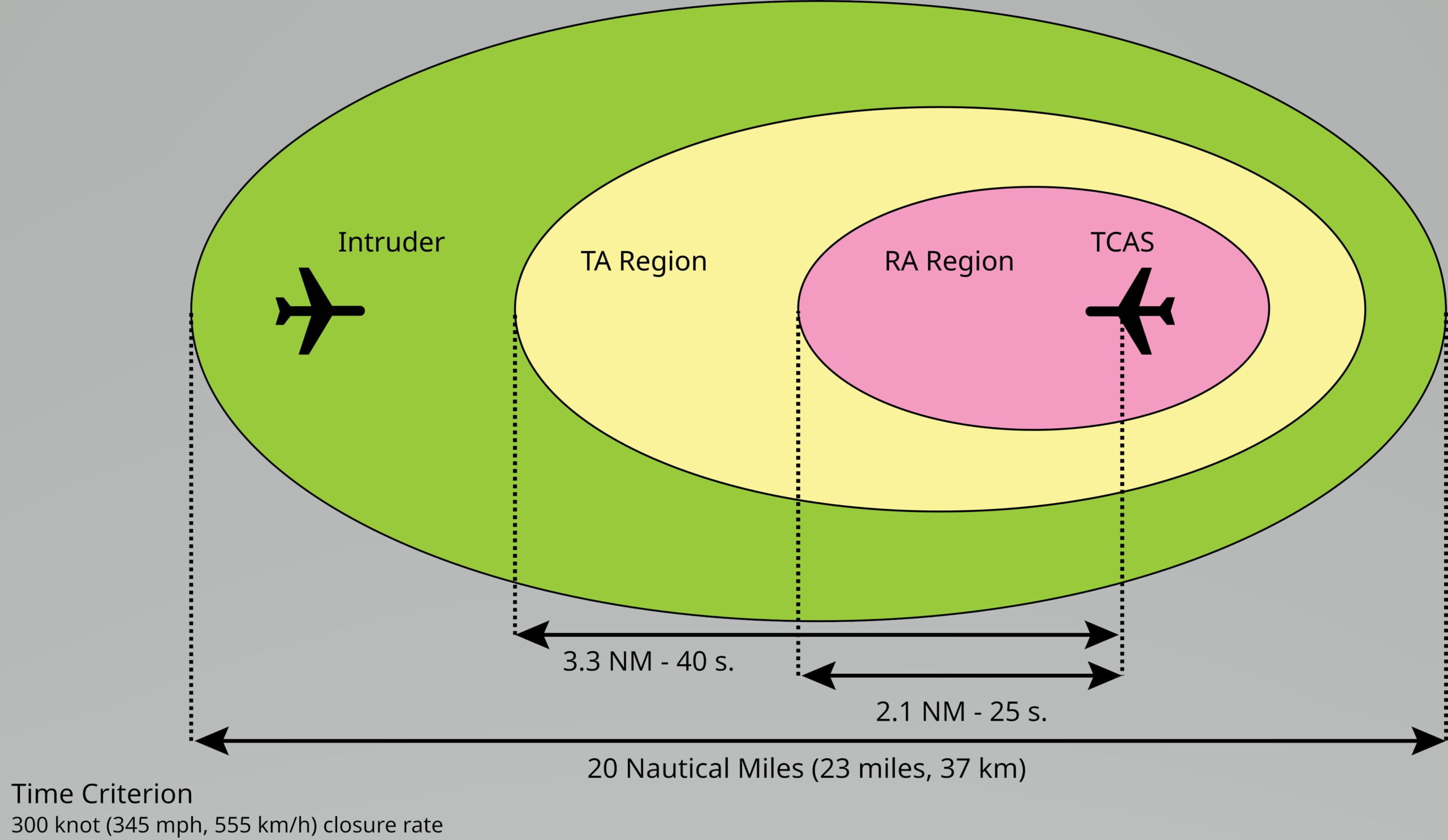
Unlike ground radar, TCAS works independently inside the aircraft.
Each aircraft equipped with TCAS:
- Interrogates nearby transponders
- Tracks their altitude and closing rate
- Predicts potential collisions
- Issues instructions to pilots
The system can command pilots to climb or descend to avoid another aircraft.
When two TCAS-equipped aircraft meet, they coordinate their maneuvers automatically so that one climbs while the other descends.
Mandatory Installation
Following years of testing, TCAS became mandatory.
In the United States:
- Airliners with more than 30 seats were required to carry TCAS II
- Smaller aircraft were required to carry TCAS I
By the early 1990s, TCAS had become standard equipment in airline cockpits.
How Many Accidents Has TCAS Prevented?
Because TCAS prevents accidents before they happen, it is difficult to measure its full impact.
However, aviation safety studies show that TCAS has resolved thousands of potential near mid-air collisions.
The system is now considered one of the most important safety technologies ever introduced in commercial aviation.
A System Born From Tragedy
Modern air travel is extraordinarily safe, but many of its safeguards were written in tragedy.
The development of TCAS is a perfect example.
Each major mid-air collision forced engineers, regulators, and airlines to improve the system.
Today, when a pilot hears the words:
“Clear of conflict.”
It means the system worked and another accident has been quietly prevented.