Thunderstorms remain one of aviation’s most serious hazards. Hidden inside towering convective clouds are violent turbulence, intense rainfall, lightning, hail, and dangerous windshear that can threaten even the most advanced aircraft.
To avoid these hazards, modern airline crews rely on sophisticated onboard weather radar systems capable of detecting storm activity hundreds of miles ahead of the aircraft. Among the most advanced of these systems is the Collins MultiScan Weather Radar, a technology designed to automatically detect hazardous weather while significantly reducing pilot workload.
Unlike earlier radar systems that required constant manual adjustment, modern digital weather radar combines automated scanning, advanced signal processing, and intelligent filtering algorithms to present pilots with a clearer and more reliable picture of the atmosphere ahead.
The Aircraft That Introduced MultiScan
The aircraft to showcase this technology was a special variant of the Boeing 747.
The first Boeing 747-400ER (Extended Range) was delivered to Qantas on October 31, 2002. Registered as VH-OEF and named “Sydney,” the aircraft marked the introduction of a new long-range version of the iconic jumbo jet.
Only six 747-400ER aircraft were ever built, and Qantas was the only airline to order the passenger version of the type. Designed to operate longer sectors than the standard 747-400, the aircraft was powered by General Electric CF6 engines, providing the thrust and efficiency needed for extended long-haul operations.
VH-OEF also holds a place in avionics history. The aircraft served as the launch platform for the Collins MultiScan weather radar system, helping introduce a new generation of automated airborne weather detection technology.
By pairing the 747-400ER’s long-range capability with advanced radar technology, the aircraft demonstrated how improved weather awareness could enhance both safety and operational efficiency on intercontinental routes.

Why Weather Radar Is Critical for Flight Safety
While aircraft are engineered to withstand severe weather conditions, the safest strategy is always avoidance rather than penetration.
Inside powerful thunderstorms, pilots may encounter:
- Severe turbulence capable of injuring passengers and crew
- Microbursts and windshear that can dramatically reduce aircraft performance
- Intense precipitation and hail
- Rapid vertical air movements
- Lightning activity
Airborne weather radar allows flight crews to detect these weather systems long before they become a threat, enabling strategic route deviations and safer flight planning.
However, interpreting radar returns has traditionally required considerable experience and careful adjustment of the radar system itself.
The Basics of Airborne Weather Radar
Aircraft weather radar works by transmitting pulses of microwave energy from an antenna housed inside the aircraft’s nose radome. These radar pulses travel forward through the atmosphere until they encounter precipitation such as rain, hail, or water droplets within clouds.
When the energy strikes these particles, a portion of the signal reflects back toward the aircraft and is received by the radar system. The strength of this returned signal known as reflectivity determines how precipitation appears on the cockpit display.
In general, stronger returns indicate heavier precipitation.
Within a typical thunderstorm, radar reflectivity tends to vary vertically:
- Lower regions often produce the strongest radar returns due to heavy rainfall.
- Mid-level regions contain a mixture of water droplets and ice particles, producing more moderate returns.
- Upper storm regions are dominated by ice crystals, which reflect radar energy much less effectively.
Because the most hazardous precipitation usually occurs in the lower portions of storms, airborne weather radar systems are designed to scan these areas carefully.
The Challenge of Traditional Radar Systems
Earlier generations of airborne weather radar required pilots to manually manage two key controls: tilt and gain.
Tilt
Tilt controls the vertical angle of the radar beam relative to the aircraft.
If the radar beam is tilted too far downward, it may detect terrain reflections known as ground clutter, which can obscure weather targets. If tilted too far upward, the radar beam may overshoot the most reflective portions of a storm entirely.
Gain
Gain adjusts the sensitivity of the radar receiver.
Excessive gain can exaggerate weak returns, making minor precipitation appear more dangerous than it actually is. Too little gain may hide significant weather echoes.
Balancing these controls required both experience and constant attention, particularly during long flights or when operating near complex weather systems.
The MultiScan Approach
The Collins MultiScan Radar system was designed to simplify this process by automating much of the radar interpretation workload.
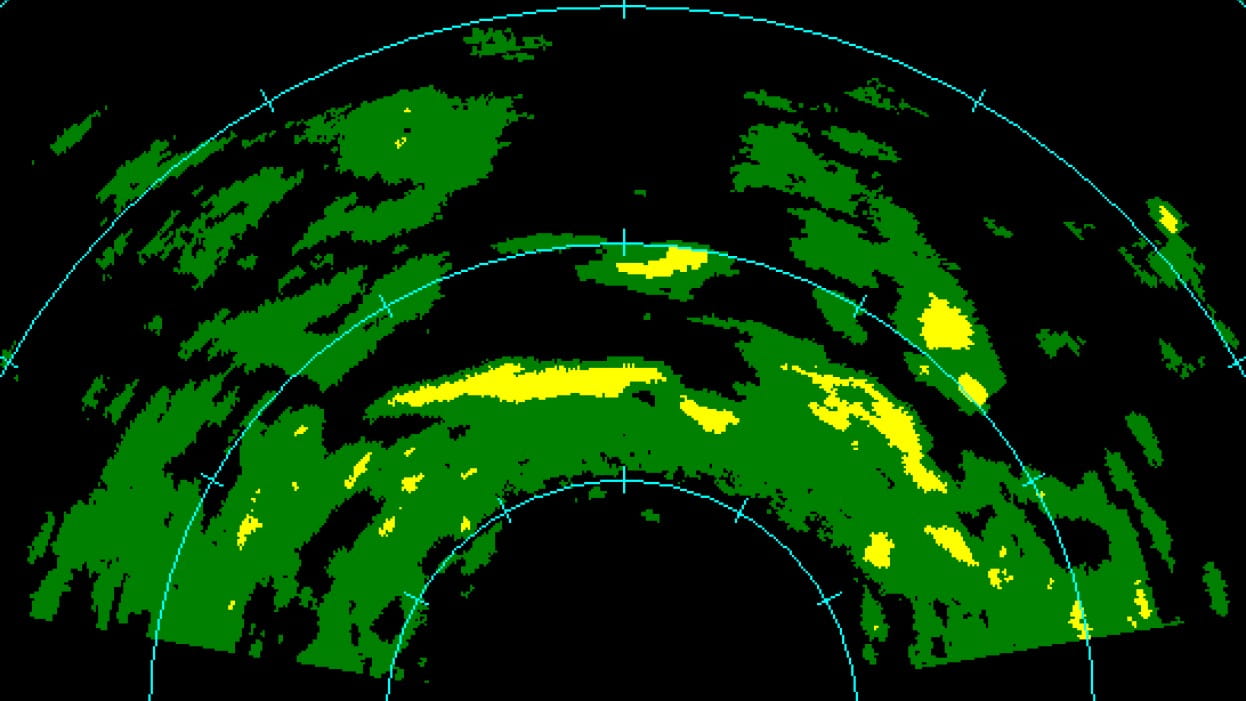
Instead of scanning the atmosphere with a single beam angle, MultiScan performs multiple scans at different tilt angles. The system then processes and combines these scans using advanced digital algorithms to generate a single optimized weather display.
This approach allows the radar to construct a more accurate picture of the weather environment ahead while minimizing the need for manual adjustments by the flight crew.
Following the Curvature of the Earth
One of the fundamental challenges for airborne weather radar is the curvature of the Earth and the way weather behaves in the equatorial region vs the rest of the world. The weather also behaves differently over Land vs Sea.
Over a distance of roughly 320 nautical miles, the Earth’s surface drops away by approximately 65,000 feet. A single fixed radar beam cannot maintain an ideal scanning angle across such a long distance.
MultiScan addresses all of these limitations by combining multiple radar beams at different angles to approximate an ideal scanning pattern. A patented geographic database helps consolidate results, improving the detection of weather both near the aircraft and at longer ranges.
Multi-Beam Weather Detection
The radar system typically performs two primary scans:
- An upper scan, which focuses on detecting weather at intermediate distances.
- A lower scan, which captures precipitation closer to the aircraft as well as long-range weather targets.
The system stores the results of these scans in memory and merges them into a unified display, allowing pilots to view weather from directly ahead of the aircraft out to distances of 320 nautical miles.
Reducing Pilot Workload Through Automation
One of the most significant advantages of modern radar systems like MultiScan is their fully automatic operation.
In automatic mode, pilots typically only need to select the desired radar range. The system then automatically adjusts:
- Tilt angle
- Receiver gain
- Scanning patterns
By handling these adjustments internally, the radar maintains optimal performance regardless of altitude, terrain, or phase of flight.
This automation allows pilots to focus more attention on strategic weather avoidance decisions rather than managing radar settings.
Eliminating Ground Clutter
Ground clutter has long been one of the most challenging issues for airborne radar systems. Terrain reflections can appear as strong radar returns, sometimes masking dangerous weather echoes.
MultiScan uses advanced signal-processing algorithms to filter out approximately 98 percent of ground clutter, dramatically improving the clarity of the radar display.
This capability is particularly important during:
- Low-altitude flight
- Climb and descent phases
- Operations near mountainous terrain
By removing unwanted reflections, the system allows pilots to identify hazardous weather more easily.
Strategic Weather Awareness at Long Range
Because MultiScan combines multiple radar scans and applies sophisticated filtering techniques, it provides long-range strategic weather awareness out to 320 nautical miles.
This extended detection capability allows flight crews to identify large weather systems early and plan course deviations well before the aircraft reaches hazardous conditions.
Early detection can mean the difference between a minor route adjustment and a complex tactical maneuver later in the flight.
Predictive Windshear Detection
Many modern airborne radar systems also incorporate predictive windshear detection, a feature that is especially critical during takeoff and landing.
The radar monitors changes in wind velocity ahead of the aircraft that may indicate the presence of dangerous windshear or microbursts. If such conditions are detected, the system provides cockpit alerts to warn the crew of the potential hazard.
These alerts give pilots valuable time to take corrective action during some of the most demanding phases of flight.
A Major Step Forward in Weather Avoidance
Advances in digital radar technology have significantly improved aviation safety over the past several decades.
Systems such as the Collins MultiScan Weather Radar provide:
- Automated storm detection
- Reduced ground clutter
- Long-range weather awareness
- Predictive windshear alerts
- Lower pilot workload
By automating many of the complex tasks once required to interpret radar returns, modern weather radar systems allow flight crews to focus on the most important strategy of all: staying well clear of hazardous weather.