The Airline That Built Global Aviation
For much of the twentieth century, Pan American World Airways was not simply an airline it was the symbol of global aviation itself. From pioneering intercontinental air travel to introducing the jet age to the traveling public, Pan Am helped define what international aviation would become.
Yet despite its extraordinary legacy, the airline collapsed in 1991 after years of financial struggle, geopolitical shocks, and strategic missteps. The story of Pan Am is therefore both a triumph of aviation innovation and a cautionary tale about the volatile economics of global airlines.
The Birth of an Aviation Pioneer
Pan American Airways was founded in 1927 during a period when international aviation was still experimental. The airline’s first flight was a modest mail service between Key West, Florida, and Havana, Cuba, operated with a single aircraft.
Under the leadership of aviation entrepreneur Juan Trippe, the company quickly expanded. Trippe believed that aviation would eventually connect the entire world, and he aggressively pursued government contracts, international route rights, and aircraft development partnerships.
During the 1930s Pan Am built the first true global airline network, linking the United States to Latin America, the Caribbean, and eventually across the Pacific Ocean.
At a time when most airlines operated small land-based aircraft, Pan Am introduced large flying boats capable of crossing oceans.
These aircraft included:
- Sikorsky S-42 flying boats
- Martin M-130 “China Clippers”
- Boeing 314 transoceanic flying boats
The famous “Clipper” services connected San Francisco to Asia and New York to Europe, making Pan Am the first airline to operate regular transoceanic passenger flights.
For many travelers, flying with Pan Am represented the height of luxury and adventure.
The Airline That Built the Jet Age
Pan Am’s influence extended far beyond route development. The airline also played a crucial role in shaping aircraft technology.
In the 1950s Juan Trippe pushed aircraft manufacturers to build a new generation of jet airliners capable of carrying large numbers of passengers across oceans. Pan Am placed major orders with both Boeing and Douglas, accelerating the development of the Boeing 707 and Douglas DC-8.
When Pan Am introduced the Boeing 707 in 1958, it effectively launched the Jet Age.
Suddenly transatlantic travel times were cut in half. Long-distance air travel became faster, safer, and more comfortable than ever before.
Pan Am soon became the dominant international airline in the world.
By the 1960s the airline served:
- Europe
- Asia
- Africa
- South America
- The Middle East
- Australia
Few airlines had anything close to Pan Am’s global reach.
The Birth of the Jumbo Jet
Pan Am’s most famous contribution to aviation came in the late 1960s.
Juan Trippe approached Boeing with an ambitious request: build an aircraft twice the size of any existing airliner.
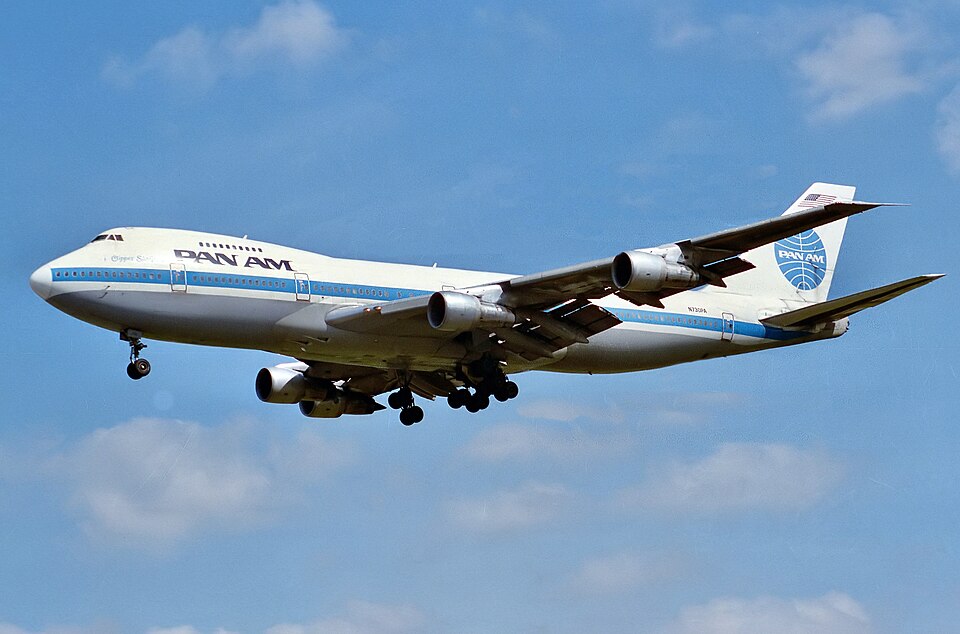
The result was the Boeing 747, the world’s first wide-body airliner.
Pan Am placed the launch order for 25 Boeing 747 aircraft in 1966, a massive commitment worth over $500 million at the time.
When the first Pan Am 747 entered service in 1970, it revolutionised commercial aviation.
The aircraft could carry more than 350 passengers and dramatically lowered the cost of long-haul air travel. This helped turn international flying from an elite luxury into mass transportation.
For many years the sight of a Pan Am 747 became synonymous with global travel.
A Structural Weakness: No Domestic Network
Despite its global prestige, Pan Am had a fundamental weakness.
Unlike most major airlines, it had no domestic U.S. route network.
This limitation dated back to American aviation regulation during the mid-twentieth century. Domestic routes were controlled by the Civil Aeronautics Board and assigned to specific airlines.
Pan Am was designated primarily as an international carrier, meaning it depended on other airlines to feed passengers into its long-haul flights.
This structure worked well during the regulated era, but it would later become a serious disadvantage.
The Oil Crisis and Rising Costs
The first major shock came in the 1970s.
The 1973 oil crisis caused aviation fuel prices to rise dramatically. Airlines operating large long-haul fleets, like Pan Am, were particularly vulnerable.
Operating the new Boeing 747 aircraft suddenly became much more expensive.
At the same time global economic instability reduced passenger demand.
Pan Am’s financial position began to weaken.
Airline Deregulation Changes the Game
Another major turning point occurred in 1978 when the United States deregulated its airline industry.
Deregulation allowed airlines to freely compete on routes and pricing.
Domestic airlines rapidly expanded international services, eroding Pan Am’s historic advantage.
Competitors such as:
- TWA
- United Airlines
- American Airlines
began operating their own international routes.
For the first time, Pan Am faced direct competition on the global stage.
Strategic Decisions That Hurt the Airline
During the 1980s Pan Am made several major strategic decisions in an attempt to survive.
One of the most controversial was the purchase of National Airlines in 1980.
The acquisition was intended to give Pan Am a domestic network. However, the merger proved extremely difficult and expensive.
Integration problems included:
- incompatible fleets
- labour conflicts
- complex route structures
Instead of strengthening the airline, the acquisition created new financial pressures.
Pan Am was forced to sell valuable assets, including its prestigious Pan Am Building in New York and portions of its international route network.
The Lockerbie Disaster
In December 1988 Pan Am suffered another devastating blow.
Pan Am Flight 103, a Boeing 747 flying from London to New York, was destroyed by a terrorist bomb over Lockerbie, Scotland.
All 259 people on board and 11 people on the ground were killed.
The tragedy severely damaged the airline’s reputation and led to massive legal liabilities.
Passenger bookings declined sharply.
The Final Collapse
By the early 1990s Pan Am was struggling to survive.
The airline attempted several restructuring efforts, including selling profitable routes to competitors such as Delta Air Lines.
However, these asset sales only delayed the inevitable.
In January 1991 Pan Am filed for bankruptcy protection.
Later that year the airline ceased operations entirely.
After more than six decades of pioneering global aviation, the airline that had once defined international air travel disappeared.
Pan Am’s Lasting Legacy
Although the airline itself no longer exists, Pan Am’s influence on aviation remains enormous.
The company helped create many elements of modern air travel, including:
- global airline networks
- intercontinental passenger routes
- jet-powered long-haul travel
- wide-body airliners
- international aviation branding
Pan Am also played a key role in developing the infrastructure and regulatory systems that support modern global aviation.
In many ways, the airline built the foundations of the international aviation industry that exists today.
Conclusion
The rise and fall of Pan American World Airways illustrates both the brilliance and fragility of aviation.
Pan Am pioneered global air travel and introduced the technologies that transformed aviation into a worldwide industry.
Yet economic shocks, deregulation, and strategic missteps ultimately brought down one of the most iconic airlines ever created.
Even today, decades after its final flight, the blue globe logo of Pan Am remains one of the most recognisable symbols in aviation history.