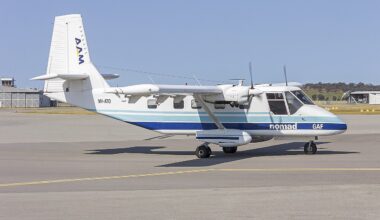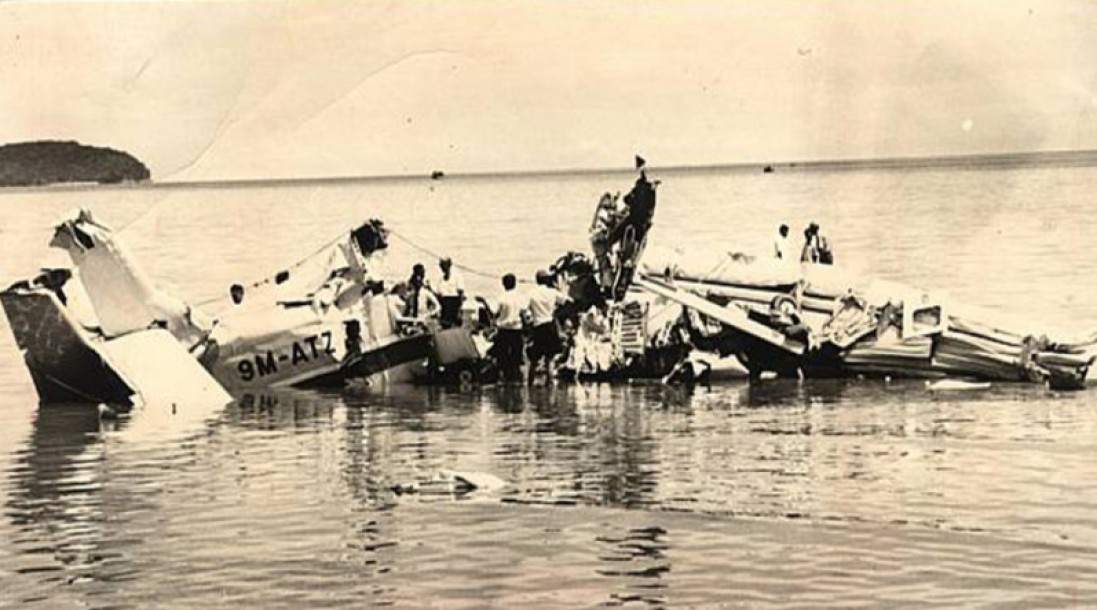
On 6 June 1976, a GAF Nomad N.22B operated by Sabah Air crashed shortly after takeoff from Kota Kinabalu, Sabah, Malaysia. The aircraft was carrying senior political leaders, including the Chief Minister of Sabah. All on board were killed.
The accident became known as the “Double Six” crash, named after the date 6/6/1976 and it remains one of the most politically significant aviation accidents in Malaysian history.
For the Nomad programme, it marked a reputational turning point.
The Aircraft and Flight Profile
The aircraft involved was a GAF Nomad N.22B, manufactured by the Australian Government Aircraft Factories (GAF). The Nomad was designed as a Short Take-Off and Landing (STOL) utility aircraft capable of operating from short, remote airstrips.
The aircraft departed Kota Kinabalu for a short domestic flight to Labuan. Shortly after takeoff, witnesses reported abnormal flight behaviour before the aircraft descended and impacted terrain near Sembulan.
The crash occurred within minutes of departure.
Official Findings
The official investigation concluded that the accident resulted from loss of control shortly after takeoff, attributed primarily to issues relating to aircraft loading and centre-of-gravity (CG) positioning.
Key factors identified included:
- The aircraft was reportedly loaded beyond allowable limits.
- The centre of gravity was assessed to have been outside approved parameters.
- Possible interference with flight controls due to unsecured cargo was considered.
- The aircraft entered a steep nose-up attitude followed by loss of control.
The findings emphasised weight and balance mismanagement rather than inherent aerodynamic instability.
The Political Dimension
The political context amplified scrutiny.
Those killed included Sabah’s Chief Minister and other senior government figures. The loss altered the political trajectory of Sabah and Malaysia.
Because of the political sensitivity, the accident report remained classified for decades. This delay fuelled speculation and conspiracy theories regarding the cause of the crash.
When the report was eventually declassified many years later, it largely reaffirmed the original technical conclusions concerning loading and operational factors.
However, the long period of restricted public access allowed suspicion to take root.
Did the Double Six Crash Indict the Nomad’s Design?
Technically, the official findings did not conclude that the Nomad suffered from an inherent design flaw.
However, the crash added to existing concerns about the Nomad’s handling characteristics particularly:
- Sensitivity to aft centre-of-gravity loading
- Pitch authority in low-speed regimes
- STOL configuration effects on stability margins
The Nomad’s design philosophy prioritised short-field performance. STOL aircraft often operate closer to aerodynamic margins than conventional commuter aircraft.
Critics argued that such sensitivity required exceptional discipline in weight-and-balance control. Supporters countered that any aircraft loaded outside its approved envelope can become uncontrollable.
The debate became less about legality and more about operational robustness.
The Reputation Effect
Even where technical causation is clear, perception can diverge from engineering.
The Double Six crash created:
- Heightened scrutiny of the Nomad internationally
- Political association with a high-profile fatal event
- Long-term reputational drag on the programme
In aviation markets, reputation is capital. Once confidence is questioned particularly in export markets recovery becomes difficult.
Broader Nomad Context
The Double Six accident did not occur in isolation.
The Nomad programme faced:
- Criticism over handling characteristics in other jurisdictions
- Export market challenges
- Comparisons with more stable commuter aircraft such as the Beechcraft King Air
- Industrial pressures as a government-backed programme
The crash intensified these pressures.
Conspiracy Theories and Declassification
Because the accident involved senior political figures and the report was withheld from public release for decades, alternative theories flourished.
These included speculation about:
- Sabotage
- Political motivations
- Suppression of findings
However, when declassified, the report did not substantiate such claims. The technical conclusions remained focused on weight distribution and operational control.
In aviation history, prolonged classification often creates suspicion irrespective of technical truth.
The Structural Lesson
The Double Six crash highlights three enduring aviation principles:
- Weight and balance discipline is absolute.
Even well-designed aircraft can become uncontrollable outside approved CG limits. - STOL aircraft demand precise loading management.
Designs optimised for short-field performance may have narrower stability margins at certain loading extremes. - Political context magnifies aviation events.
When accidents intersect with government leadership, the consequences extend beyond engineering.
Legacy
The Nomad programme would continue for years after the Double Six accident, but the event contributed to the aircraft’s complex legacy.
Today, the Double Six crash is remembered as:
- A political watershed in Sabah
- A defining moment in the Nomad’s public history
- An example of how operational discipline and aircraft design interact under scrutiny
It remains a case study in the intersection of aviation safety, political consequence and industrial ambition.