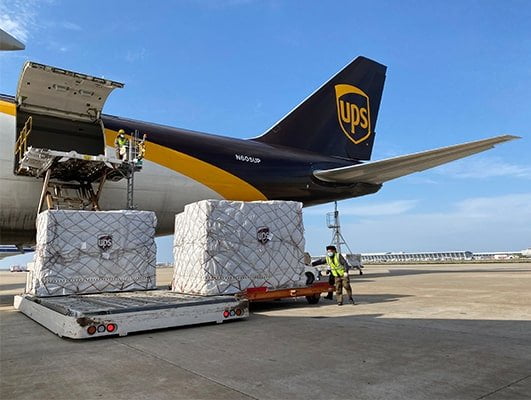
How the Air Freight Industry Sustained Global Aviation
When COVID-19 grounded global passenger aviation, one sector accelerated rather than contracted: air cargo.
As commercial fleets were parked and terminals fell silent, freighters continued operating at intensity levels rarely seen outside wartime logistics. Aircraft carrying up to 100 tonnes of medical equipment, pharmaceuticals, personal protective gear (PPE), and essential goods became critical infrastructure.
The impact of COVID-19 on the air freight industry was not merely operational it was strategic. Cargo shifted from secondary revenue stream to aviation lifeline.
Impact of COVID-19 on Air Freight Industry Capacity
Before the pandemic, approximately 40% of global air cargo was transported in the belly hold of passenger aircraft. The remaining 60% moved via dedicated freighters.
When passenger demand collapsed falling more than 60% globally in 2020 belly capacity evaporated almost overnight.
This created an immediate supply shock in global air freight capacity. By late March 2020, trans-Pacific air freight rates had reportedly tripled as demand for medical and essential goods surged.
Despite widespread lockdowns, global cargo demand remained resilient. Supply chains continued operating. E-commerce volumes expanded. Medical logistics required speed.
While passenger aviation stalled, air cargo demand remained structurally active.
Passenger Aircraft Converted to Cargo: The Rise of “Preighters”
One of the most defining operational adaptations of the pandemic was the conversion of passenger aircraft to cargo-only operations.
More than 20 airlines deployed passenger fleets in freight roles, loading cargo into cabins secured with netting. These aircraft often referred to as “preighters” helped mitigate the sudden loss of belly capacity.
Airlines including:
- United Airlines
- Delta Air Lines
- Cathay Pacific
- American Airlines
- Southwest Airlines
operated cargo-only flights using aircraft traditionally configured for passenger service.
United Airlines alone conducted approximately 1,100 cargo flights in May 2020, with further expansion scheduled. Southwest introduced cargo-only charter operations on Boeing 737 aircraft an operational shift for a domestic passenger carrier.
With passenger traffic declining by as much as 94% in some markets, cargo operations preserved:
- Aircraft utilisation
- Crew currency
- Airport operational continuity
- Critical revenue streams
Antonov An-225 and Large-Scale Medical Supply Airlifts
On 13 April 2020, the Antonov An-225 Mriya the world’s largest cargo aircraft landed in Warsaw carrying 81.3 tonnes of epidemic prevention materials from Tianjin, China.
The aircraft’s cavernous hold was filled to nearly four-fifths of capacity with medical supplies, masks, and testing equipment. The operation was widely reported as one of the largest pandemic-related air cargo shipments during the crisis.
Such flights became symbolic of air cargo’s expanded strategic role in global crisis logistics.
Air Cargo Revenue Growth During the Pandemic
While passenger airlines reported historic losses, cargo operators experienced revenue uplift.
Atlas Air, for example, reported a US$23.4 million profit in Q1 2020, compared with a US$30 million loss during the same period the previous year.
Carriers operating for Amazon and other e-commerce platforms saw significant revenue growth as online purchasing accelerated under lockdown conditions.
Although cargo alone could not offset total passenger revenue loss, it provided critical liquidity for airlines and stabilised airport operations.
Cargo-Only Flights and Airline Resilience
Many airlines that had not operated cargo-only services in decades re-entered the freight market.
Widebody aircraft previously configured for international passenger routes were deployed exclusively for cargo operations. American Airlines, for example, operated approximately 140 widebody weekly cargo flights during the pandemic, with planned increases.
The use of larger passenger aircraft for freight sometimes allowed consolidation of cargo loads that would otherwise require multiple freighters, improving fuel efficiency and operational economics.
Cargo operations proved structurally more adaptable than passenger networks during social distancing restrictions.
Why Air Cargo Became Core Aviation Infrastructure
COVID-19 reframed cargo from supplementary revenue stream to strategic pillar.
Air cargo operations offer several structural advantages:
- Lower passenger-contact exposure
- Greater automation potential
- Easier integration of AI and digital logistics systems
- Reduced terminal congestion compared with passenger hubs
Airports with strong cargo infrastructure particularly in the U.S. Midwest accelerated investment in cargo-centric facilities and improved road connectivity to capture long-term freight demand.
The pandemic highlighted that cargo handling capacity is not peripheral — it is core aviation infrastructure.
The Future of Air Cargo After COVID-19
Industry forecasts suggest passenger traffic recovery may take several years. During this transition period, airlines with diversified cargo capability are structurally better positioned.
Long-term implications include:
- Greater investment in dedicated freighters
- Flexible passenger-to-cargo conversion capability
- Integration of cargo into network planning
- Enhanced supply chain partnerships
Cargo professionals, historically secondary within passenger-focused airlines, are now central to strategic planning.
Conclusion: From Supporting Role to Strategic Engine
The air cargo industry during COVID-19 did not simply compensate for passenger losses it sustained global trade, delivered critical medical supplies, and preserved aviation system relevance.
The crisis did not create cargo’s importance. It revealed it.
As commercial aviation recalibrates post-pandemic, air freight has secured a permanent elevation in strategic priority. For airlines, airports, and regulators, cargo is no longer ancillary it is foundational.