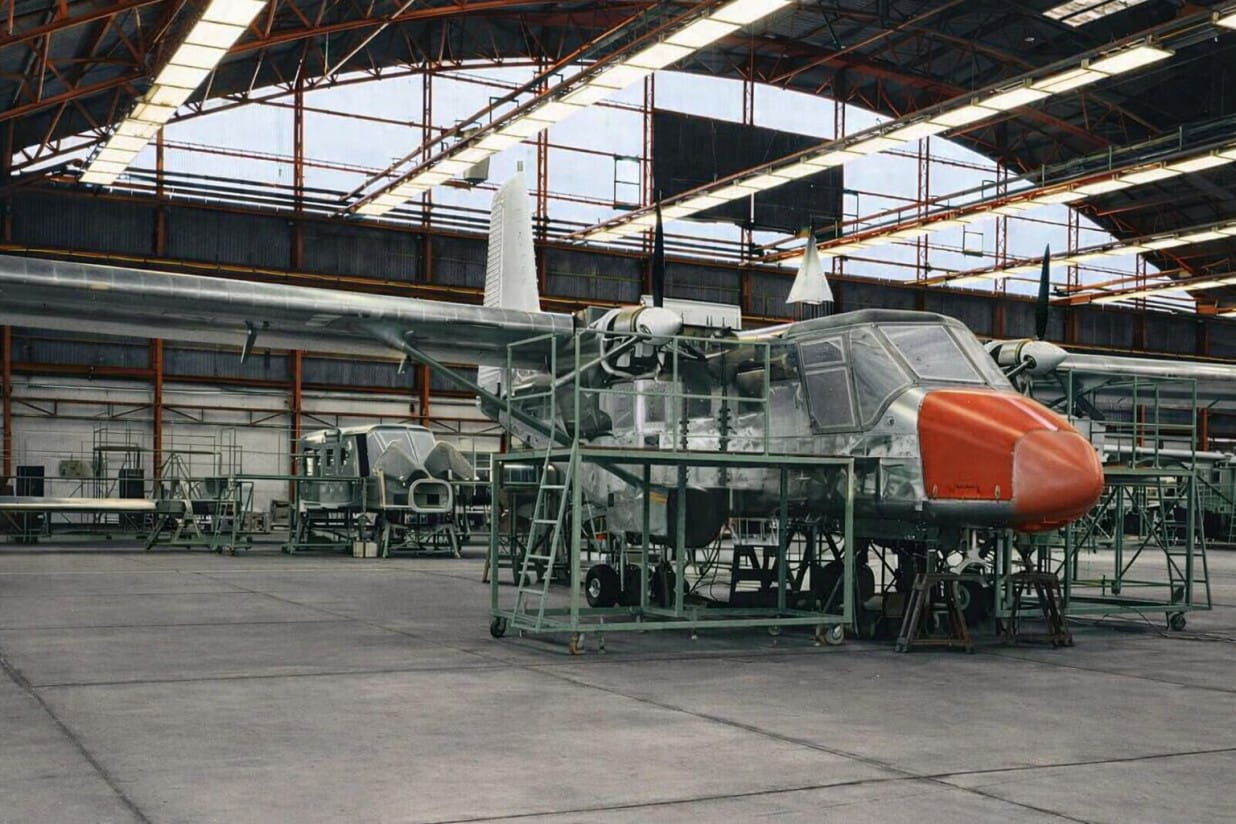
In the late 1960s, Australia’s Government Aircraft Factories (GAF) began work on a new aircraft the Nomad intended to serve both civilian and military operators. Known internally as Project N, the design aimed to produce a rugged twin-engine utility transport capable of operating from short and remote airstrips.
Government funding for two prototypes was approved in January 1970, and the aircraft that emerged from the program would become known as the GAF Nomad.
Early Nomad Development
The Nomad’s first prototype, VH-SUP (constructor’s number 01), completed its maiden flight on 23 July 1971. Although the aircraft was originally expected to receive an Aboriginal name, the simpler title “Nomad” was ultimately chosen.
Two primary versions were developed:
- N22 – the military utility aircraft (later produced as the N22B)
- N24 – a lengthened version designed primarily for commercial use
In 1972, the Australian government approved an initial production order for 20 aircraft, including 11 for the Australian Army. This order was expanded the following year by an additional 50 aircraft.
The second prototype, VH-SUR, incorporated design improvements such as an enlarged fin and raised rudder to improve stability. The aircraft was displayed internationally at the 1972 Farnborough Air Show, showcasing Australia’s growing aircraft manufacturing capability.
Entry into Service
The first production aircraft remained with GAF as a demonstration platform. The second aircraft, VH-EPG, entered civilian service with Nationwide Air Services on 30 April 1975.
The Australian Army received eleven Nomads between 1975 and 1977, where they were commonly referred to as “Mission Masters.” These aircraft were operated primarily by No. 173 (General Support) Squadron and the School of Army Aviation at Oakey, Queensland.
The first Army example, A18-303, first flew on 20 June 1975 and was delivered later that year. Before full operational service, the aircraft underwent evaluation by the RAAF Aircraft Research and Development Unit (ARDU) at RAAF Laverton.
Flight Characteristics and Controversy
During testing and operational use, the Nomad attracted criticism regarding several aspects of its handling. Reports suggested the aircraft could be difficult to control in certain configurations, particularly during short take-off and landing (STOL) operations with flaps extended.
Other concerns raised by operators included:
- Limited single-engine performance
- Sensitivity to centre-of-gravity loading
- Technical issues associated with the tailplane
GAF defended the aircraft, arguing that some evaluations used military operational criteria that were not necessarily applicable to civilian operations.
The N24 and the Searchmaster
A stretched version of the aircraft, the N24, was introduced to expand the Nomad’s commercial capability. However, development suffered a major setback when the prototype VH-SUZ crashed on 6 August 1976 due to tailplane flutter, resulting in the loss of two key members of the development team.
Despite this tragedy, the N24A production model was later granted a Certificate of Airworthiness in October 1977.
Another specialized variant was the N22S Searchmaster, designed for maritime surveillance. The first example, VH-SBY, flew in November 1979 and was easily recognized by its chin-mounted radar housing.
International Operators
Although the Nomad never became a major export success, it did find operators across the Asia-Pacific region.
Export customers included:
- Indonesia – 16 N22S Searchmasters for the Indonesian Navy
- Philippines – 12 N22B aircraft purchased in 1978, with four more added in 1990
- Thailand – 20 aircraft for the Royal Thai Air Force, plus additional aid aircraft
- Papua New Guinea – six aircraft supplied through Australian aid programs
The Royal Thai Navy also received several N24A variants.
Production Ends
By 1982, the Australian government decided to limit the program to 170 aircraft. At its peak, the GAF production line was capable of building up to 24 aircraft annually.
Production officially ended in 1984, with the final Nomad making its first flight on 28 June 1985.
Unsold aircraft were placed in storage at Oaklands in New South Wales. In 1987, several of these aircraft were transferred to the Australian military when commercial buyers could not be found.
Later Service
Additional Nomads were assigned to both the Australian Army and the Royal Australian Air Force during the late 1980s. Some aircraft underwent extensive modifications before entering service.
Army Nomads eventually adopted a camouflage scheme of tan, light green, and black, introduced in 1984. This replaced the earlier dark green and day-glo orange colors that had proven highly visible.
Despite its operational versatility, the Nomad remained somewhat unpopular within parts of the Australian military aviation community.
Nomad Legacy
The Nomad program represented a significant chapter in Australia’s domestic aircraft manufacturing industry. While the aircraft filled a useful niche as a short-field transport and surveillance platform, its operational reputation remained mixed.
Some aviation historians have suggested that the end of Nomad production was influenced by the need to focus industrial resources on larger defense programs, including the F/A-18 Hornet.
Even so, the Nomad remains an important example of Australian aerospace engineering and continues to attract interest among aviation enthusiasts and historians.