How Canada’s Regional Jet Became One of Aviation’s Biggest Success Stories
For more than three decades, the Bombardier CRJ (Canadair Regional Jet) family quietly transformed short-haul aviation.
While wide-body aircraft and long-haul jets capture most of the headlines, the CRJ became one of the most influential aircraft families ever built. It connected smaller cities to global airline networks, reshaped regional airline economics, and introduced a generation of pilots to modern glass-cockpit regional jets.
By the time production ended in 2020, nearly 2,000 CRJ aircraft had been built, making it the most successful regional jet family in aviation history.
The aircraft’s success was not accidental. It was the result of clever engineering, a rapidly expanding regional airline market, and advanced avionics systems such as the Collins Pro Line 4 (PL4) flight deck, which brought large-aircraft technology to the regional market.
The Origins of the Canadair Regional Jet
The story of the CRJ begins with a business jet.
During the 1970s and 1980s, Canadian manufacturer Canadair developed the CL-600 Challenger business jet. Bombardier acquired Canadair in 1986 and saw the opportunity to create a new category of aircraft: the regional jet.
Engineers soon realised the basic airframe could be stretched and adapted into a small airliner. Instead of using turboprop aircraft, airlines could operate a small jet airliner with similar speed and comfort to larger narrow-body aircraft.
The result was the CRJ100, which first entered airline service in 1992 with Lufthansa CityLine.
The timing was perfect.
After airline deregulation in the United States, carriers were expanding hub-and-spoke networks. Regional jets allowed airlines to feed passengers from smaller cities into major hubs efficiently.
The First Generation: CRJ100 and CRJ200
The original CRJ aircraft were designed for the 50-seat regional market, a segment that had previously been dominated by turboprops.
Key features included:
- seating for around 50 passengers
- two General Electric CF34 turbofan engines
- cruise speeds comparable to larger airliners
- lower operating costs than traditional narrow-body jets
The aircraft proved extremely reliable early in its life.
During its first 100 days in service, the CRJ100 achieved 99% dispatch reliability, while fuel consumption was reported to be 8% better than predicted.
Airlines quickly adopted the aircraft.
Major operators included:
- Delta Connection
- Lufthansa CityLine
- SkyWest Airlines
- Brit Air
The follow-on CRJ200 offered improved range and efficiency and quickly became the backbone of many regional airline fleets.
Stretching the Design: The CRJ700
As regional aviation expanded in the late 1990s, airlines wanted larger aircraft that could carry more passengers but still maintain the economics of the CRJ.
Bombardier responded with the CRJ700, a stretched version capable of carrying around 70–78 passengers.
The aircraft introduced several improvements:
- redesigned wings with leading-edge slats
- improved aerodynamics
- more powerful GE CF34-8 engines
- increased range and payload capability
The CRJ700 first flew in 1999 and entered airline service in 2001.
This version allowed airlines to serve higher-demand regional routes without moving to larger narrow-body aircraft like the Boeing 737 or Airbus A320.
The Next Generation: CRJ900 and CRJ1000
Bombardier continued to expand the CRJ concept through further fuselage stretches.
CRJ900
The CRJ900 increased capacity to 76–90 passengers, improving seat-mile economics and competing directly with the Embraer E-Jet family.
CRJ1000
The final evolution of the design was the CRJ1000, capable of carrying up to 100 passengers.
Despite the larger cabin, Bombardier maintained strong commonality across the entire aircraft family.
Pilots could transition between variants with minimal additional training, and airlines benefited from shared maintenance systems and spare parts.
The Role of Pro Line 4 (PL4) Avionics
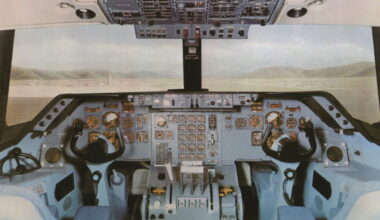
One of the CRJ’s most important technological features was its Collins Pro Line 4 (PL4) avionics system.
The PL4 flight deck was originally developed for larger commercial aircraft and business jets, bringing modern glass-cockpit technology to the regional jet market.
Key features included:
- Electronic Flight Instrument System (EFIS) displays
- integrated flight management system (FMS)
- digital autopilot and flight director
- advanced navigation and weather radar integration
- engine monitoring systems
The system replaced traditional electromechanical gauges with large electronic displays, reducing pilot workload and improving situational awareness.
For many pilots, the CRJ became their first experience flying a modern glass cockpit airliner.
Why the CRJ Became So Successful
Several factors contributed to the extraordinary success of the CRJ program.
Perfect Timing
The aircraft entered service just as airlines were expanding regional networks following deregulation in North America.
Jet Comfort on Regional Routes
Passengers preferred jets over turboprops because of:
- faster cruise speeds
- smoother rides
- quieter cabins
Operational Flexibility
The CRJ allowed airlines to serve routes that were too small for larger aircraft but too long for turboprops.
Fleet Commonality
All CRJ variants shared similar systems and cockpit layouts, reducing training and maintenance costs.
A Global Regional Jet Network
At its peak, the CRJ family operated in nearly every region of the world.
By 2015 the fleet was performing over 200,000 flights per month worldwide, representing more than 20% of all jet departures in North America.
Regional airlines used the aircraft to connect hundreds of smaller cities to major hubs such as:
- Atlanta
- Chicago
- Frankfurt
- Paris
- Toronto
For many communities, the CRJ was the aircraft that brought reliable jet service to regional airports.
The End of Production
Despite its success, changing market conditions eventually slowed CRJ sales.
Airlines began favouring larger regional jets such as the Embraer E-Jet family, which offered wider cabins and improved passenger comfort.
In 2020 Bombardier sold the CRJ program to Mitsubishi Heavy Industries, marking the end of Bombardier’s involvement in commercial airliner manufacturing.
The final aircraft, a CRJ900, was delivered to SkyWest Airlines in 2021.
The Legacy of the CRJ
Although production has ended, the CRJ continues to fly around the world.
Hundreds remain in service with regional airlines, and many pilots began their airline careers in its cockpit.
More importantly, the aircraft proved that small jet airliners could be economically viable, fundamentally changing airline route structures.
In doing so, the Bombardier CRJ became one of the most influential aircraft families in the history of regional aviation.