How Juan Trippe and Boeing Changed Global Aviation
Few aircraft have transformed aviation as dramatically as the Boeing 747, and few airlines were as closely tied to its creation as Pan American World Airways. When the aircraft entered service in 1970, it revolutionised international air travel by dramatically increasing passenger capacity and lowering ticket prices.
Yet the story of the Boeing 747 is inseparable from the ambitions of Pan Am’s visionary founder Juan Trippe, whose push for a larger, more efficient aircraft helped shape the future of global aviation.
Pan Am’s Vision for Mass Air Travel
During the 1960s Pan Am dominated international aviation. However, Juan Trippe believed the next challenge was making long-haul travel affordable for the masses rather than a luxury reserved for wealthy travellers.
Trippe approached Boeing with an ambitious request: design an aircraft capable of carrying twice as many passengers as existing jetliners.
At the time the largest commercial aircraft was the Boeing 707, typically carrying around 150 passengers on long-haul routes. Trippe wanted an aircraft that could carry more than 350 passengers, dramatically reducing the cost per seat.
Boeing Takes the Risk
Boeing’s president Bill Allen agreed to the challenge. In 1966 Pan Am placed an order for 25 Boeing 747 aircraft, worth more than $500 million, making it one of the largest commercial aircraft orders in aviation history at the time.
The risk was enormous.
Developing the 747 required Boeing to:
- Build the world’s largest commercial aircraft
- Construct a new assembly plant in Everett, Washington
- Develop new high-bypass turbofan engines
The result was the Boeing 747-100, a wide-body aircraft with a distinctive upper deck and four engines.
The First Jumbo Jet Flight
On 22 January 1970, Pan Am operated the first commercial Boeing 747 flight between New York and London.
The aircraft immediately captured public imagination. The spacious cabin, spiral staircases, and upper-deck lounge created an experience unlike anything passengers had previously encountered.
The 747 also dramatically increased global airline capacity, allowing airlines to carry far more passengers on long-haul routes.
The Aircraft That Changed Aviation Economics
The Boeing 747 fundamentally reshaped airline economics.
By carrying hundreds of passengers on a single flight, airlines could reduce ticket prices and expand international travel markets.
This helped transform aviation into a mass transportation system rather than a luxury experience.
However, the aircraft also created new challenges for Pan Am. Operating such large aircraft required consistently high passenger demand, making airlines vulnerable during economic downturns.
Pan Am and the Jumbo Jet Legacy
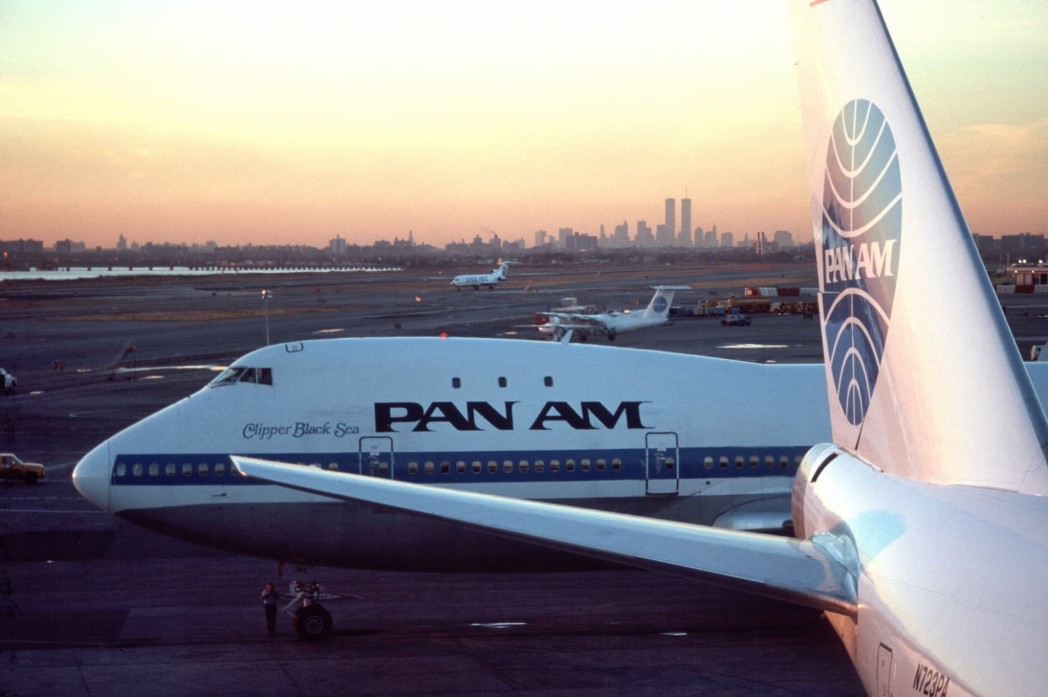
For decades the Boeing 747 remained the flagship aircraft of Pan Am’s international network.
The image of a Pan Am Boeing 747 crossing the Atlantic became one of the defining symbols of global aviation.
Although Pan Am ultimately collapsed in 1991, its role in launching the Boeing 747 ensured its place in aviation history.
Without Pan Am’s bold vision, the Jumbo Jet era may never have happened.