The Regional Jet Rivalry That Changed Airline Networks
For much of the modern airline era, the most important competition in commercial aviation has not taken place between wide-body giants or long-haul aircraft, but in the regional jet market. Two aircraft families in particular came to dominate this sector: the Bombardier CRJ series from Canada and the Embraer E-Jet family from Brazil.
Together they reshaped airline economics, connected hundreds of smaller cities to global hub networks, and transformed how passengers experience short-haul travel.
While these aircraft rarely attract the attention given to flagship airliners like the Boeing 747 or Airbus A380, they have quietly become some of the most influential aircraft in modern aviation.
The Birth of the Regional Jet
The regional jet revolution began in the early 1990s when Bombardier introduced the Canadair Regional Jet (CRJ100).
Derived from the Canadair Challenger business jet, the aircraft demonstrated that small jet airliners could economically replace turboprops on regional routes. Airlines quickly realised the advantages:
- Higher cruise speeds
- Improved passenger appeal
- Better integration with hub-and-spoke airline networks
Passengers also preferred jets over turboprops, helping regional airlines attract more travellers.
The CRJ concept proved so successful that Bombardier rapidly expanded the design into a full aircraft family:
- CRJ100 / CRJ200 – 50 seat aircraft
- CRJ700 – 70 seat stretch
- CRJ900 – up to 90 passengers
- CRJ1000 – approaching narrow-body capacity
By the early 2000s, the CRJ had become the backbone of regional airline fleets across North America and Europe.
Embraer’s Different Strategy
Brazilian manufacturer Embraer took a very different approach.
Rather than stretching an existing aircraft design, the company developed a completely new regional airliner family known as the E-Jets.
Introduced in the early 2000s, the new aircraft included:
- E170
- E175
- E190
- E195
These aircraft were designed from the beginning as small commercial airliners rather than modified business jets.
The result was a wider fuselage, improved cabin comfort, and passenger amenities more typical of larger aircraft.
Design Philosophy: Efficiency vs Comfort
The CRJ and Embraer E-Jets represent two distinct aircraft design philosophies.
Bombardier CRJ
The CRJ inherited the slim fuselage of its Challenger business-jet origins. This narrow profile created a lightweight and aerodynamically efficient aircraft that delivered excellent operating economics.
Airlines appreciated the CRJ because it:
- Burned relatively little fuel
- Required minimal pilot retraining between variants
- Fit easily into high-frequency regional networks
Embraer E-Jets
Embraer focused more heavily on passenger experience.
The E-Jets were designed with:
- A wider cabin
- Larger overhead bins
- Bigger windows
- A spacious 2-2 seating configuration
For passengers, the aircraft felt closer to a mainline narrow-body airliner than a traditional regional jet.
The CRJ900 vs Embraer E175
The most direct competitors in the regional market are the CRJ900 and the Embraer E175.
These aircraft operate in the same segment and are commonly used by regional airlines flying on behalf of major carriers.
Typical specifications include:
| Aircraft | Typical Seats | Range | Role |
|---|---|---|---|
| CRJ900 | 76–90 | ~1,550 nm | Regional hub feeder |
| E175 | 76–88 | ~2,200 nm | Regional hub feeder |
Both aircraft dominate short-haul airline networks, particularly in North America.
The Influence of U.S. Scope Clauses
One of the most unusual factors shaping the regional jet market is the scope clause.
These contractual agreements between airline pilots and airlines restrict the size of aircraft that regional affiliates can operate.
Typical scope clause limits include:
- Maximum 76 seats
- Maximum takeoff weight of 86,000 pounds
As a result, aircraft such as the CRJ900 and Embraer E175 were specifically optimised for this market segment, making the 76-seat regional jet the most important category in regional aviation.
Avionics and Technology
Both aircraft families introduced advanced avionics systems for regional airline operations.
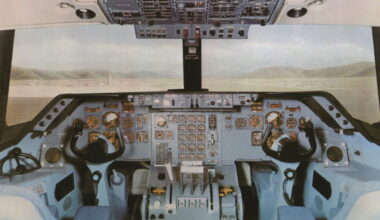
Early CRJ aircraft incorporated the Collins Pro Line 4 (PL4) avionics suite, which provided:
- Electronic flight instrument displays
- Integrated flight management system
- Digital autopilot and flight director
- Weather radar and navigation integration
These systems brought airline-level glass cockpit technology to regional aircraft.
Embraer followed with highly integrated avionics systems designed to reduce pilot workload and provide improved flight deck ergonomics.
For many airline pilots, the CRJ or E-Jet cockpit represented their first experience operating a fully digital flight deck.
Passenger Experience
While the CRJ often held a slight edge in operating efficiency, the Embraer E-Jets gained a reputation for superior passenger comfort.
Passengers generally prefer the E-Jet because of:
- Wider cabin
- Larger windows
- More spacious seating
- No middle seats
These factors helped the Embraer E175 become one of the most popular regional aircraft in North America during the 2010s.
The End of the CRJ Program
Despite the success of the CRJ family, Bombardier eventually exited the commercial aircraft market.
In 2020 the CRJ program was sold to Mitsubishi Heavy Industries, marking the end of Bombardier’s involvement in commercial airliner production.
By that time nearly 2,000 CRJ aircraft had been built, making it one of the most successful regional aircraft families in aviation history.
The Legacy of the Regional Jet
Together, the CRJ and Embraer E-Jets fundamentally reshaped the airline industry.
They allowed airlines to:
- connect smaller cities to global hubs
- increase flight frequency
- operate routes too small for larger aircraft
Today regional jets perform thousands of flights every day worldwide, quietly forming the backbone of modern airline networks.
While they may not capture the spotlight like long-haul aircraft, these jets have played an essential role in making global air travel accessible to millions of passengers.
Conclusion
The rivalry between the Bombardier CRJ and Embraer E-Jets defined the evolution of regional aviation.
Bombardier’s CRJ family pioneered the concept of the regional jet and proved its economic viability. Embraer responded with a new generation of aircraft designed to improve passenger comfort and airline flexibility.
Together these aircraft families built the modern regional airline network that connects cities across the world today.