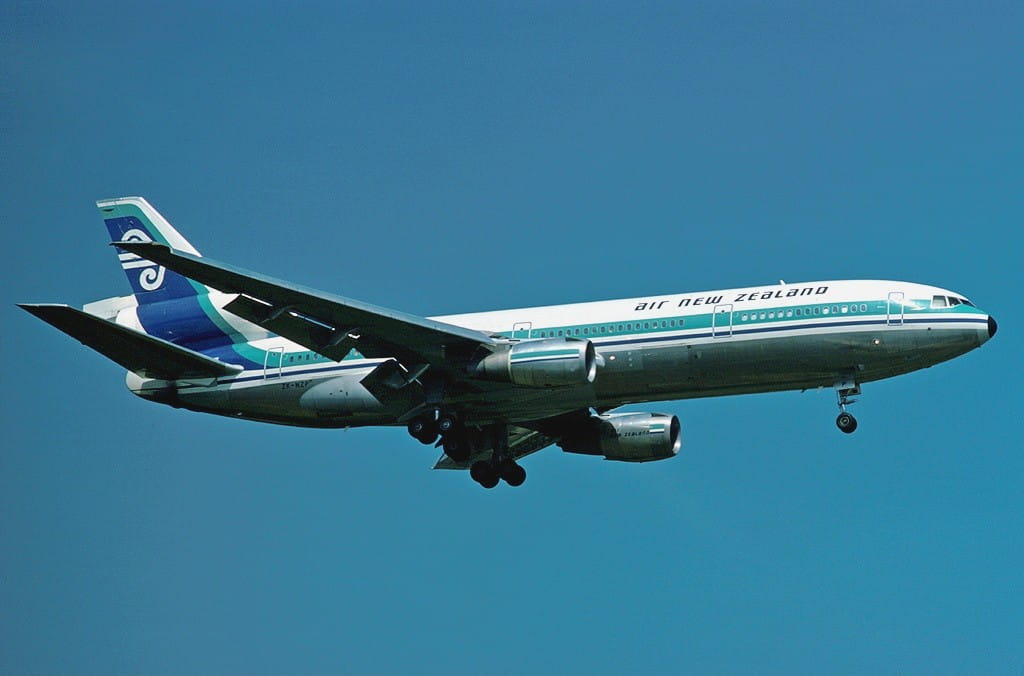
On 28 November 1979, Air New Zealand Flight TE901, a sightseeing flight to Antarctica, ended in tragedy when its McDonnell Douglas DC-10 flew directly into the slopes of Mount Erebus on Ross Island.
All 257 passengers and crew were killed, making it one of the deadliest aviation disasters in New Zealand history.
For decades the accident has been debated, analyzed, and misunderstood. But a detailed investigation including overseas evidence gathered by the Royal Commission revealed how a combination of navigation assumptions, radar limitations, and an extraordinary Antarctic visual illusion led to catastrophe.
The disaster was not caused by a single mistake.
Instead, it was the result of a perfect storm of technology, environment, and human perception.
The Antarctic Sightseeing Flights
During the late 1970s Air New Zealand operated popular Antarctic sightseeing flights using wide-body DC-10 aircraft.
Passengers departed Auckland, flew south over the Ross Sea, and descended to low altitude to view the spectacular Antarctic landscape before returning to New Zealand.
The flights were considered safe and had operated successfully before.
But Antarctica is one of the most deceptive flying environments on Earth.
Air Traffic Control at McMurdo Sound
During the Royal Commission investigation, evidence was taken from U.S. Navy personnel responsible for air traffic control at McMurdo Station.
These controllers monitored aircraft operating near Ross Island, including the sightseeing DC-10.
Their testimony revealed several key points:
- The DC-10 was never seen on radar at McMurdo.
- Controllers expected the aircraft to arrive down the center of McMurdo Sound, the normal route taken by previous flights.
- The U.S. Navy had no authority to control civil aircraft flight paths, except for maintaining separation from military traffic.
When TE901 failed to report its position as expected, controllers attempted multiple radio calls.
But by then the aircraft had already crashed.
Could the DC-10 Radar Have Seen the Mountain?
One of the most controversial questions after the accident was whether the DC-10’s Bendix weather radar should have warned the pilots that they were approaching terrain.
Investigators travelled to the Bendix Avionics Division in Florida, where engineers explained the real capabilities and limitations of the system.
The answer surprised many people.
Weather radar is not terrain radar.
Aircraft weather radar is designed to detect rain droplets in clouds, not mountains.
The radar works by transmitting radio waves and detecting reflections from moisture.
Clouds containing rain or water droplets return strong radar signals.
But Antarctica presents a completely different environment.
Why Ice Confuses Radar
In polar regions, radar behaves very differently.
According to Bendix engineers:
- Dry snow and ice absorb radar energy
- Radio waves penetrate ice rather than reflecting off it
- Returns from ice surfaces appear weak and blurred
This means the radar cannot clearly distinguish between:
- pack ice
- ice shelves
- snow-covered mountains
All three surfaces can produce almost identical radar returns.
As a result, a radar display may show a continuous flat surface even when the aircraft is approaching a mountain.
For Flight TE901, the radar likely showed the same weak signal from Mount Erebus that it had been receiving from surrounding pack ice.
In other words, the radar provided no useful warning.
The Polar Whiteout Phenomenon
While radar limitations were important, the most powerful factor in the crash was something pilots call whiteout.
Whiteout is a unique visual condition common in polar regions.
It occurs when:
- snow covers the ground
- the sky is overcast
- sunlight reflects from both surfaces
Under these conditions, the horizon disappears.
Shadows vanish.
Contrast disappears.
Depth perception collapses.
Everything becomes a uniform white field.
Investigators consulted several world experts on visual perception in aviation, including U.S. Air Force and Navy specialists.
Their conclusion was clear:
A pilot flying toward a snow-covered mountain under these conditions may see nothing but flat terrain ahead.
When a Mountain Looks Like Flat Ice
The slopes of Mount Erebus rise gradually from the Ross Ice Shelf.
Under normal conditions the mountain is clearly visible.
But under whiteout lighting, the slopes reflect light in such a way that they blend seamlessly into the surrounding snowfields.
To the human eye, the rising terrain can appear completely flat.
Experts explained that the pilots of TE901 likely saw:
- a vast white surface stretching into the distance
- two dark rock areas to the left and right
- no visible horizon
- no shadows to reveal slope
Without visual cues, the brain automatically interprets the scene as flat terrain.
This illusion is so powerful that even experienced pilots can be deceived.
The Role of Human Perception
One of the most fascinating aspects of the investigation was the role of human perception.
Experts emphasized that:
The eye does not simply record reality, it interprets it.
The brain constantly compares what we see with what we expect to see.
If a pilot believes the aircraft is flying down the center of McMurdo Sound, far from mountains, the brain will naturally interpret visual cues in a way that supports that belief.
This psychological effect is called confirmation bias.
Even if small visual inconsistencies appear, the brain tends to ignore them unless they become extreme.
The result can be a self-reinforcing illusion.
A Perfect Illusion
Experts who studied the accident reconstructed what the pilots likely saw.
From the cockpit:
- dark rock outcrops on either side resembled the entrance to McMurdo Sound
- the white terrain ahead appeared flat
- the overcast sky blended with the snow surface
- depth cues were completely absent
The aircraft was flying toward a slope rising 13–19 degrees, but visually it appeared level.
According to visual perception specialists, this was a classic example of Antarctic visual deception.
Why Experience Matters in Polar Flying
The U.S. Navy witnesses emphasized a critical point during the investigation.
Pilots operating in Antarctica normally require special polar training and experience.
In U.S. Navy operations:
- pilots must accumulate at least 20 hours flying over Antarctic terrain before commanding aircraft in the region.
The reason is simple.
Polar flying involves visual illusions that cannot be fully explained in briefings or manuals.
They must be experienced to be understood.
Without that experience, a pilot may trust visual cues that are fundamentally misleading.
The Final Moments
Evidence from the cockpit voice recorder suggests that the crew believed they were flying safely over flat ice.
They saw what appeared to be clear terrain ahead.
In reality, the aircraft was approaching the slopes of Mount Erebus.
At 3,000 feet, there was no terrain warning system and no radar indication of danger.
Seconds later the DC-10 struck the mountain at high speed.
Lessons from the Erebus Disaster
The Erebus crash transformed aviation safety in several ways.
It highlighted the dangers of:
- visual illusions in polar environments
- over-reliance on weather radar for terrain awareness
- operating large aircraft visually in unfamiliar terrain
Today, modern aircraft use Terrain Awareness and Warning Systems (TAWS) that would almost certainly have prevented the accident.
Advanced satellite navigation and digital terrain databases now provide pilots with far greater situational awareness.
But the Erebus disaster remains a powerful reminder that nature can still deceive even the most advanced aircraft and experienced pilots.
The Legacy of Flight TE901
More than four decades later, the crash of Air New Zealand Flight TE901 remains one of aviation’s most studied accidents.
Not because of mechanical failure.
Not because of reckless flying.
But because it demonstrated how technology, human perception, and the unique environment of Antarctica combined to create one of the most convincing illusions in aviation history.
And in aviation, illusions can be deadly.