The Regional Turboprop Rivalry That Connected Smaller Cities
During the 1980s, airlines around the world were searching for efficient aircraft capable of serving short regional routes between smaller cities. Many airports lacked long runways or sufficient passenger demand for large jet aircraft. Two turboprop aircraft emerged as key competitors in this growing market Saab 340 and de Havilland Canada Dash 8.
Both aircraft entered service in 1984, both carried roughly 30–50 passengers, and both became workhorses of regional aviation for decades. Yet despite their similar roles, the two aircraft represented very different design philosophies.
The Saab 340: Sweden’s Regional Workhorse
The Saab 340 was developed through a partnership between Saab AB of Sweden and Fairchild Aircraft in the United States. The aircraft made its first flight in January 1983 and entered airline service the following year.
The design was optimized for small regional markets, typically carrying 30–36 passengers.
Key characteristics included:
- Twin General Electric CT7 turboprop engines
- Cruise speed around 250–280 knots
- Range of roughly 900 nautical miles
- Operating ceiling of 25,000 feet
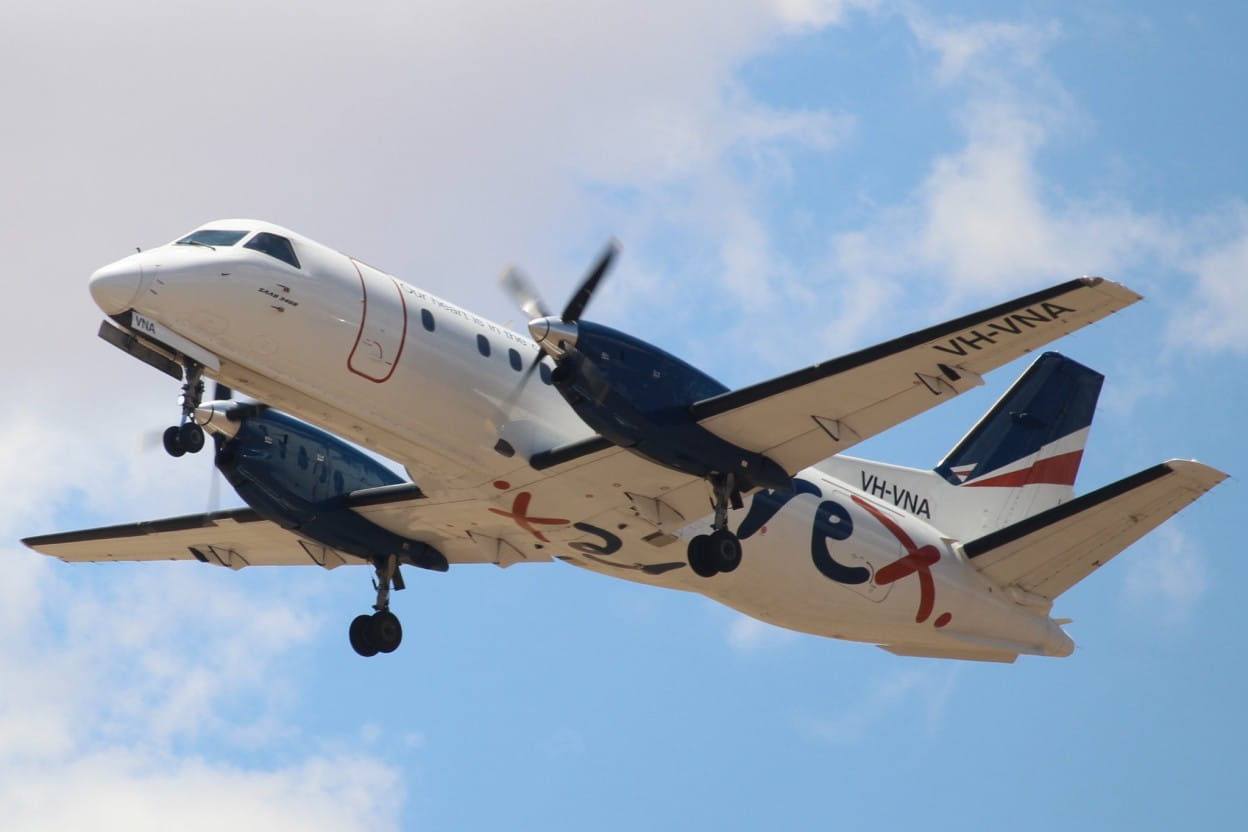
The Saab 340 became particularly popular with regional airlines in Europe, North America, and Australia. Carriers such as Regional Express (Rex) in Australia still operate the type today.
Its strengths were:
- low operating cost
- good performance from smaller airports
- rugged reliability
By the end of production in 1999, 459 Saab 340s had been built.
The Dash 8: Canada’s Regional Turboprop Family
At the same time, de Havilland Canada was developing a competing turboprop known as the Dash 8.
The aircraft first flew in 1983 and entered service in 1984, the same year as the Saab 340.
Unlike the Saab 340, the Dash 8 was designed as a family of aircraft, allowing airlines to operate multiple sizes for different route demands.
Variants included:
- Dash 8-100 / -200 – around 37–40 passengers
- Dash 8-300 – around 50 passengers
- Dash 8-400 (Q400) – up to 68–90 passengers
The Dash 8 incorporated several distinctive features:
- High aspect-ratio wing for efficiency
- T-tail configuration
- strong short-field performance
Later models, particularly the Q400, became one of the fastest turboprops ever built, cruising around 360 knots (667 km/h).
More than 1,250 Dash 8 aircraft were produced across all variants.
Design Philosophy: Small Specialist vs Flexible Family
One of the biggest differences between the aircraft was their design strategy.
Saab 340
The Saab 340 was designed primarily as a single-size regional aircraft. Airlines typically used it on routes carrying 20–35 passengers, replacing older aircraft like the Fairchild Metroliner or Beech 99.
Dash 8
The Dash 8, by contrast, evolved into a scalable platform. Airlines could operate:
- small Dash 8-100 aircraft for thin routes
- larger Dash 8-300 aircraft for busier sectors
- high-capacity Q400 turboprops on short mainline routes
This flexibility helped the Dash 8 remain competitive for decades.
Shared Avionics: Collins Pro Line II CRT Cockpits
One fascinating technical similarity between the two aircraft was their early adoption of glass cockpit avionics.
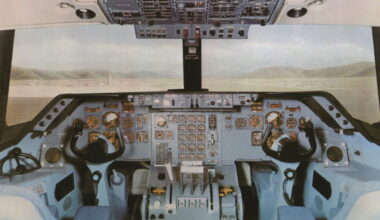
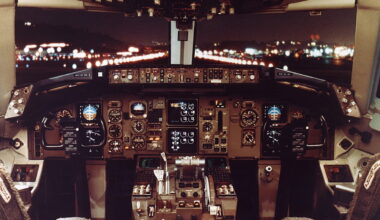
Both the Saab 340 and the Dash 8 were equipped with Collins Pro Line II (PL2) avionics systems, which used CRT flight displays rather than traditional mechanical gauges.
During the early 1980s, this represented a significant technological transition in commercial aviation.
The Pro Line II system introduced:
- electronic attitude indicators
- horizontal situation displays (HSI)
- electronic flight director systems
- integrated navigation displays
These CRT screens replaced large clusters of individual mechanical instruments, reducing cockpit complexity and improving situational awareness for pilots.
At the time, Collins avionics were already being installed in many larger aircraft, including early glass-cockpit airliners such as the Boeing 757 and 767. Bringing this technology into regional turboprops allowed smaller aircraft to benefit from the same advances in avionics integration.
For regional airlines transitioning from older aircraft types, the PL2 system represented a major step toward modern digital flight decks.
Years later, Thomas-Global would provide a Plug & Play LCD replacement for both aircraft.
Performance Comparison
| Feature | Saab 340 | Dash 8-100 / 300 | Dash 8-400 |
|---|---|---|---|
| Typical passengers | 30–36 | 37–50 | 68–90 |
| Cruise speed | ~250–280 kt | ~285 kt | up to 360 kt |
| Range | ~900 nm | ~900–1100 nm | ~1100 nm |
| Entry into service | 1984 | 1984 | 2000 |
In practice, the Saab 340 competed most directly with the smaller Dash 8-100 and -200 models, while the later Q400 operated in a higher-capacity category.
Passenger Experience
Passengers often noticed differences between the two aircraft.
The Dash 8 generally offered a slightly larger cabin, particularly in the later Q-Series aircraft, while the Saab 340 was more compact.
Later Dash 8 models also introduced active noise and vibration suppression systems, significantly reducing cabin noise.
Despite this, both aircraft became familiar sights on short regional flights worldwide.
Airlines That Operated Each Aircraft
Saab 340 operators
- Regional Express (Australia)
- American Eagle
- Loganair
- Crossair
Dash 8 operators
- QantasLink
- WestJet Encore
- Widerøe
- Porter Airlines
The Dash 8’s larger variants allowed it to operate routes previously served by regional jets.
The End of Production
The Saab 340 ceased production in 1999 as airlines began transitioning toward larger turboprops and regional jets.
The Dash 8, however, continued evolving through the Q-Series, remaining in production for decades before manufacturing was eventually suspended in the early 2020s.
Legacy of the Saab 340 and Dash 8
Both aircraft played an essential role in the development of modern regional airline networks.
They allowed airlines to connect:
- smaller cities
- remote communities
- secondary airports
to larger aviation hubs.
The Saab 340 became one of the most reliable small turboprops ever built, while the Dash 8 evolved into one of the most successful turboprop families in aviation history.
Together, they helped define the regional airline era of the 1980s and 1990s, ensuring that even smaller communities could remain connected to the global air transport network.