The World’s Most Dangerous Airport Approach Explained
High in the Himalayas of eastern Nepal lies one of the most famous and challenging airports in the world. Tenzing–Hillary Airport, better known simply as Lukla Airport, serves as the primary gateway for climbers and trekkers heading toward Mount Everest.
Perched at an altitude of 9,334 feet (2,845 m) and surrounded by towering Himalayan peaks, Lukla has earned a reputation among pilots as one of the most demanding airfields in aviation. Its short runway, steep terrain, unpredictable weather, and the absence of a go-around option combine to create an approach unlike any other.
For aviation professionals and enthusiasts alike, Lukla represents a unique intersection of geography, aircraft performance, and pilot skill.
The Gateway to Mount Everest
Lukla Airport was built in 1964 under the direction of Sir Edmund Hillary, the New Zealand mountaineer who, together with Tenzing Norgay, became the first climbers to reach the summit of Mount Everest in 1953.
Hillary wanted a reliable air link to support the development of the Everest region, particularly for transporting supplies, medical aid, and trekking tourists.
Before Lukla’s construction, reaching the Everest region required days of trekking from lower-altitude airstrips. The new airport dramatically shortened the journey and quickly became the main aviation gateway to Everest Base Camp.
Today, Lukla handles thousands of trekkers each year, particularly during the spring and autumn climbing seasons.
A Runway Like No Other
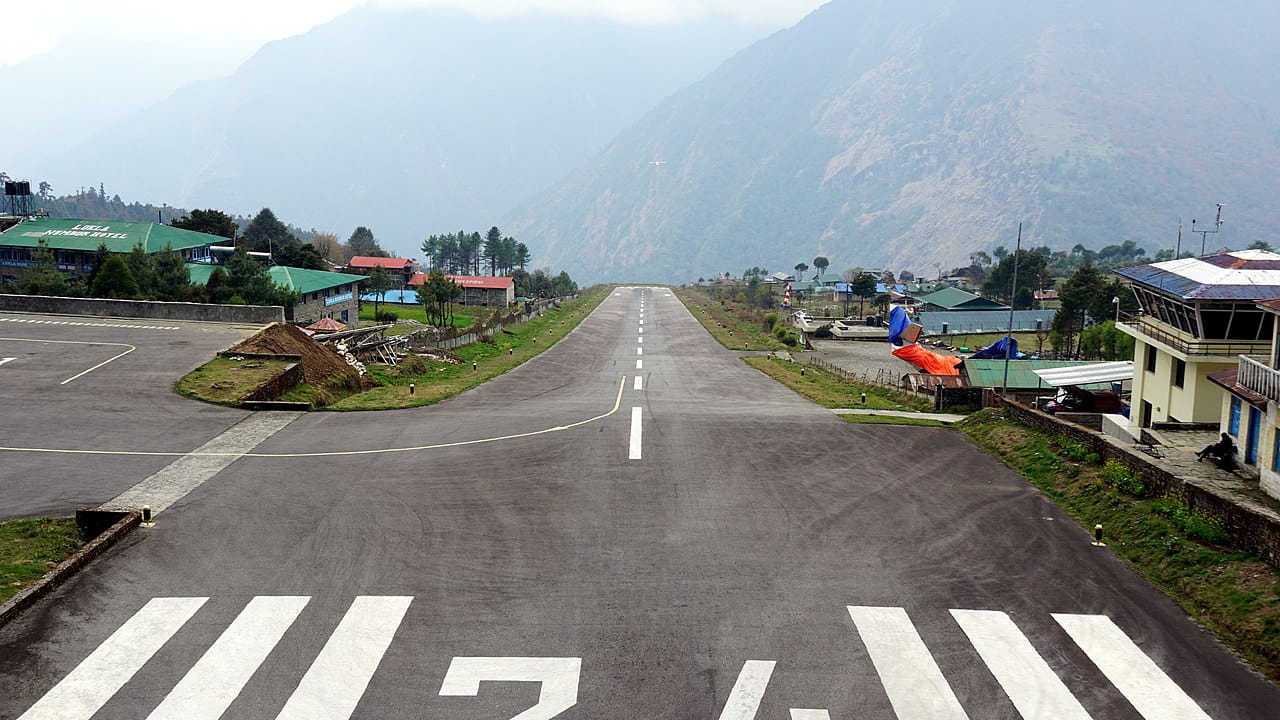
The defining feature of Lukla Airport is its extremely short runway.
Runway specifications
- Runway length: 527 metres (1,729 feet)
- Elevation: 9,334 feet (2,845 m)
- Runway gradient: approximately 12% uphill
- Runway designation: 06 / 24
Unlike typical airports, Lukla’s runway is built on a steep slope.
Aircraft land uphill toward the mountain and take off downhill toward the valley.
This design helps aircraft stop quickly after landing and accelerate more rapidly during takeoff.
However, the slope also creates unique operational challenges.
Why the Approach Is So Difficult
The Lukla approach is considered one of the most technically demanding in the world for several reasons.
1. Mountainous Terrain
The airport sits in a narrow Himalayan valley surrounded by peaks rising above 20,000 feet.
Pilots must navigate tight terrain corridors with very little margin for error.
Unlike large international airports with wide open approach paths, Lukla’s approach requires precise navigation between mountain ridges.
2. Short Runway
At only 527 metres, Lukla’s runway is dramatically shorter than those used by most commercial aircraft.
For comparison:
| Airport | Runway Length |
|---|---|
| Lukla | 527 m |
| Typical regional airport | 1,800–2,500 m |
| Major international airport | 3,000–4,000 m |
Only specialized STOL (Short Takeoff and Landing) aircraft can safely operate at Lukla.
These typically include:
- DHC-6 Twin Otter
- Dornier 228
- Let L-410
These aircraft are designed specifically for short runways and high-altitude operations.
3. No Go-Around Option
One of the most unusual aspects of Lukla Airport is that there is effectively no go-around during landing.
The runway ends at a mountain wall, leaving no space to climb away if the approach becomes unstable.
Once the aircraft commits to the final approach, the pilot must land successfully on the first attempt.
This is very different from standard airline operations, where pilots can abandon an approach and attempt another landing.
4. High Altitude Performance
Operating at nearly 9,500 feet above sea level significantly affects aircraft performance.
High altitude means lower air density, which reduces:
- engine power
- propeller efficiency
- aerodynamic lift
As a result, aircraft require longer distances to take off and land, making Lukla’s short runway even more challenging.
5. Rapidly Changing Weather
Weather in the Himalayas is notoriously unpredictable.
Lukla often experiences:
- sudden cloud formation
- strong winds
- mountain turbulence
- rapidly changing visibility
Many flights operate only in early morning hours, when weather conditions are typically more stable.
By midday, cloud build-up often forces operations to halt.
Specialized Pilot Training
Due to the airport’s difficulty, pilots must undergo special certification before operating flights to Lukla.
Requirements typically include:
- extensive mountain flying experience
- multiple supervised training flights
- familiarity with Lukla’s terrain and approach procedures
Only a small number of pilots in Nepal are authorized to fly into the airport.
Aircraft Used at Lukla
Because of the airport’s limitations, only small STOL aircraft are permitted.
Typical aircraft include:
De Havilland Canada DHC-6 Twin Otter
The most common aircraft at Lukla, known for exceptional short-field performance.
Dornier Do 228
A rugged twin turboprop capable of operating from short runways.
Let L-410 Turbolet
Another STOL turboprop used on mountain routes.
These aircraft carry 15–20 passengers, far smaller than conventional regional airliners.
Safety Record
While Lukla has experienced several accidents over the decades, most have involved weather, terrain, or operational challenges common to mountain flying.
Nepal’s Civil Aviation Authority has introduced several improvements to enhance safety, including:
- runway resurfacing
- improved weather monitoring
- stricter pilot qualification requirements
Despite its reputation, Lukla remains one of the busiest mountain airports in the world.
Why Lukla Fascinates Aviation Enthusiasts
Few airports combine so many extreme operational challenges in one location.
Lukla represents a unique example of aviation adapting to difficult geography and limited infrastructure.
Its dramatic location, demanding approach, and connection to the world’s highest mountain have made it one of the most famous airports in aviation history.
For pilots, landing at Lukla is often considered a career milestone.
For aviation enthusiasts, it remains one of the most fascinating airfields ever built.
Conclusion
Lukla Airport stands as one of aviation’s most remarkable engineering and operational achievements.
Its short uphill runway, mountainous terrain, high altitude, and lack of a go-around option make it one of the most challenging airports on Earth.
Yet every year, skilled pilots safely deliver thousands of passengers to the gateway of Mount Everest—demonstrating the extraordinary capabilities of both aircraft and aviators operating at the edge of the world’s highest mountains.