Entry into Airline Service
1974 the DC-10 has recently begun operating in commercial airline service, and many pilots will soon experience flying it for the first time. As they become familiar with the aircraft, they are likely to notice the strong handling qualities that characterize this new member of the DC aircraft family. To better understand what pilots may encounter during their initial experience, it is helpful to examine some of the key design features that contribute to the aircraft’s performance.
Initial Impression and Overall Size
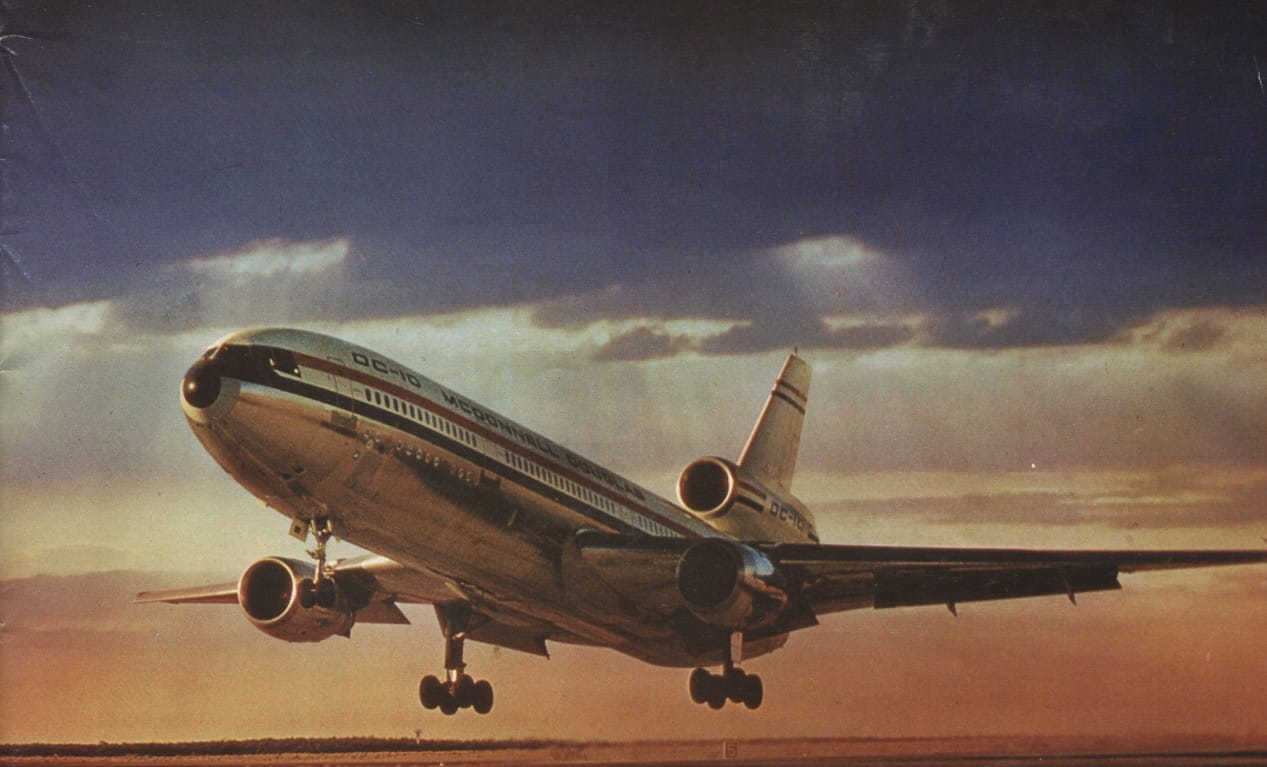
During a preflight inspection, the most noticeable feature of the DC-10 is its impressive size. The fuselage is significantly larger than those of earlier Douglas aircraft. However, the wingspan is only slightly greater than that of the DC-8-63, and the overall length of the airplane is actually somewhat shorter. Although the aircraft appears mostly conventional in its layout, several distinctive design elements can be observed.
Center Engine Design
One of the most prominent features of the DC-10 is the placement of the center engine, which uses a straight air-intake duct. Aircraft that use curved or S-shaped ducts often experience airflow distortion, which can reduce pressure recovery and create operational difficulties. The straight inlet design of the DC-10 minimizes these problems and also helps reduce aerodynamic drag across the aircraft.
Wing Configuration
When viewed from behind, the DC-10 displays a slight gull-wing shape. The inner wing sections between the fuselage and the engine nacelles have a relatively large dihedral angle, while the outer sections beyond the nacelles have a smaller angle. This design ensures sufficient ground clearance for the engines while keeping the thrust line close to the aircraft’s center of gravity. As a result, the aircraft maintains better stability and control, particularly if an engine fails.
Landing Gear and Maneuverability
The wing configuration also allows the landing gear to remain relatively short and lightweight. At the same time, it enables the aircraft to perform larger bank angles during low-altitude operations without the risk of the engine nacelles striking the ground. This balance between clearance and maneuverability contributes to the aircraft’s operational efficiency.
Control Surface Design
The elevators and rudder of the DC-10 are divided into two separate sections. Each control surface is powered by two of the airplane’s three hydraulic systems. This arrangement provides an added level of safety because the aircraft can still maintain strong control capability if one hydraulic system fails or if a hydraulic actuator becomes jammed.
Double-Hinged Rudder System
The rudder incorporates two hinge lines positioned at different points along the vertical stabilizer. Because of this configuration, both the upper and lower rudder sections consist of forward and rear portions. Hydraulic actuators move the forward sections, while mechanical linkages connect them to the rear sections. This system causes the aft part of the rudder to move relative to the fixed stabilizer structure.
Improved Rudder Performance
The use of a double-hinged rudder improves aerodynamic effectiveness. Instead of forcing the airflow to change direction in a single large movement, the design redirects the airflow in two smaller stages. This method increases rudder efficiency and greatly reduces the risk of airflow separation and buffeting at large rudder angles.
Nacelle Strakes
Another distinctive feature of the aircraft can be found on the wing-mounted engine nacelles. Small protruding surfaces known as strakes extend from the outer leading edge of each nacelle at approximately a 45-degree angle. These structures help manage airflow around the nacelles and wings, contributing to improved aerodynamic stability.
Function of Vortex Generators and Strakes
Vortex generators typically appear in rows along aircraft surfaces and are designed to energize the boundary layer of air close to the surface. By increasing the energy of this airflow, they help prevent separation of the boundary layer, which can otherwise cause buffeting, loss of control effectiveness, and increased aerodynamic drag.
The DC-10 strakes generate a single strong vortex rather than several small ones. This vortex counteracts the airflow disturbances created by the engine nacelles and pylons when the aircraft is flying at high angles of attack. As a result, these small structures play an important role in giving the DC-10 relatively low stall speeds and stable stall characteristics.
Cockpit Design and Pilot Visibility
Inside the cockpit, the pilot benefits from an exceptionally wide field of view. Large flat windshields and clear-view side windows provide a panoramic perspective of the surrounding environment. The cockpit layout itself was designed with extensive input from pilots, with a strong emphasis placed on maximizing visibility and ease of operation.
Taxi Handling Characteristics
After engine start and completion of the pre-taxi checklist, the pilot will notice that the aircraft handles smoothly while taxiing. The braking system is powerful when needed, yet the pedals allow gradual and precise control, enabling smooth movement on the ground.
Nose-wheel steering is controlled in two ways. A steering wheel is used for large directional changes during taxiing, while the rudder pedals allow smaller adjustments. The steering wheel requires minimal breakout force and responds quickly, making precise control relatively easy. Once aligned with the runway, directional control can usually be maintained using the rudder pedals alone.
Horizontal Stabilizer Setting for Takeoff
Before takeoff, the horizontal stabilizer incidence must be adjusted according to the chart provided in the FAA-approved Airplane Flight Manual. The correct setting depends on the selected flap angle and the aircraft’s center of gravity position.
The stabilizer position indicator, located on the control pedestal, includes a green band that marks the acceptable takeoff range between approximately 2 degrees airplane nose-up (ANU) and 10 degrees ANU. If the stabilizer is positioned outside this range when the throttles are advanced for takeoff, a warning horn will sound.
The same warning system also activates if a takeoff is attempted with the spoilers deployed or with the wing flaps positioned outside the approved takeoff range of 0 to 25 degrees.
Purpose of the Stabilizer Setting Range
The stabilizer settings specified in the manual represent a balance between two important factors. First, they ensure that the pilot can rotate the aircraft at the proper speed with comfortable control forces. Second, they minimize the need for trimming adjustments before reaching the initial climb speed.
Another consideration was the need to provide a takeoff green band wide enough to allow a safe takeoff even if the stabilizer is not positioned exactly at the optimal value. Nevertheless, pilots are strongly advised to set the stabilizer precisely according to the recommended chart before departure.
Takeoff Speeds and Engine Failure Procedures
Typical takeoff speeds for sea-level conditions on a standard day are provided in the flight manual charts. The minimum control speed on the ground (VMCG) at sea level is approximately 106 knots calibrated airspeed, which establishes the lower limit for the takeoff decision speed (V₁) and rotation speed (VR).
If an engine fails before reaching V₁, the takeoff must be rejected immediately by closing the throttles and stopping the aircraft. When the ground spoilers are armed prior to takeoff, they automatically deploy once reverse thrust is selected. The braking system is designed to absorb the significant energy generated when stopping from high speeds.
Recognition and Control of Engine Failures
Failure of one of the wing-mounted engines is usually easy to detect because it causes a noticeable yawing motion of the aircraft. In contrast, failure of the center engine may not produce an obvious response. For this reason, an engine-failure caution light is installed to ensure rapid identification of the problem.
If a wing engine fails after the aircraft has passed V₁, the situation can still be controlled effectively. Because V₁ is normally higher than the minimum control speed for most takeoff weights, the aircraft typically has sufficient speed and control authority to continue the takeoff safely.