The Growth of Regional Airlines (1934–1938)
The period 1934 to 1938 saw great strides in the progress of Aviation in Australia. Enterprising business men and old-established transport companies were quick to realise the importance of quicker transport in Australia. Airline companies were established in South Australia (Adelaide Airways Pty. Ltd.), Western Australia (West Australian Airways Ltd.), and Queensland (Airline of Australia Ltd.)
These companies, with headquarters in their respective capital cities, operated mainly intra-state services. Looked at from any point of view, the amalgamation of these companies was not only desirable, but inevitable.
The Formation of Australian National Airways
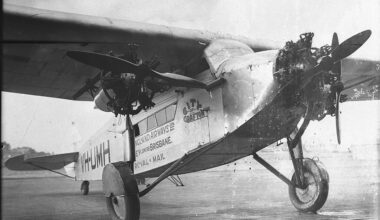
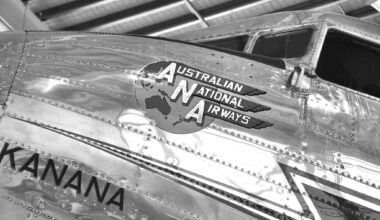
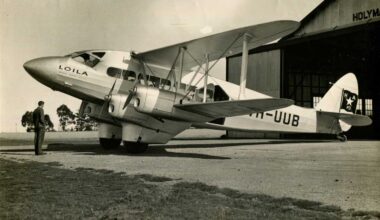
The first integration came about in 1936 when Holyman Airways Pty. Ltd. joined with Adelaide Airways Pty. Ltd., and formed Australian National Airways Pty. Ltd. – with a capital of £500,000. Foundation shareholders in A.N.A. were Holyman Bros. Pty. Ltd., Huddant Parker Ltd., Union Steamship Company of N.Z. Ltd., Adelaide Steamship Co. Ltd., and Orient Steam Navigation Co. Ltd.
With the combined operations, A.N.A. was able to operate frequent services between Hobart, Melbourne, and Adelaide, and open up passenger and trade routes between a number of important country towns in each State. The fleet and facilities of West Australian Airways Ltd., which operated a service between Perth and Adelaide, were purchased outright by A.N.A., thus extending the network to Western Australia.
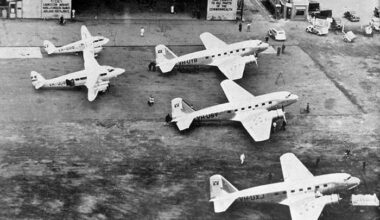
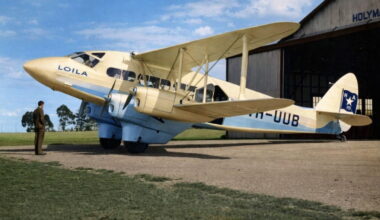
About this time, the Company acquired several DC-2 machines. The all-metal DC-2 was a very popular aircraft in the U.S. and in Europe, and was to set a new standard for reliability, safety, and passenger comfort in Australia. The era of the wood and rag aircraft was nearly over.
By means of a trading arrangement with Airlines of Australia Ltd., A.N.A. extended their air route network to Brisbane, thus linking up each capital city and serving many important country towns in all states.
Independent Airlines and the Civil Aviation Board
Several other independent airline companies were by this time firmly established. Guinea Airways Ltd. were operating local services in South Australia, and a route between Adelaide and Darwin. MacRobertson Miler Airways Ltd. were serving the north-west coast of Australia, and Butler Air Transport were doing a sterling job in pioneering and maintaining services from Sydney to north-western N.S.W., and south-west Queensland. Ansett Airways Ltd. were operating scheduled flights within Victoria, and regular services between Melbourne and Sydney.
By 1936, the Charter of the Civil Aviation Administration was inadequate to cover the now firmly established but quickly expanding aviation industry. In that year, the Commonwealth Government instituted a further change in the machinery controlling the industry. The administration was disbanded, and replaced by the Civil Aviation Board. The Board was to be responsible “under the Minister of Defence, for the Administration of the Air Navigation Regulations, and for giving effect to the Government’s policy for the further development of civil aviation in the Commonwealth”.
The effect of the new Civil Aviation Board was soon to be felt throughout the industry. In keeping with the current trend for faster and safer flying, C.A.B. planned many improvements, ranging from the system of licensing ground engineers to the establishment of a vast network of ground radio stations.
Metal Aircraft and Flying Boats
By 1938, the civil airline companies had built up a great new industry which, in a few years to come, would provide, either directly and indirectly, literally tens of thousands with employment.
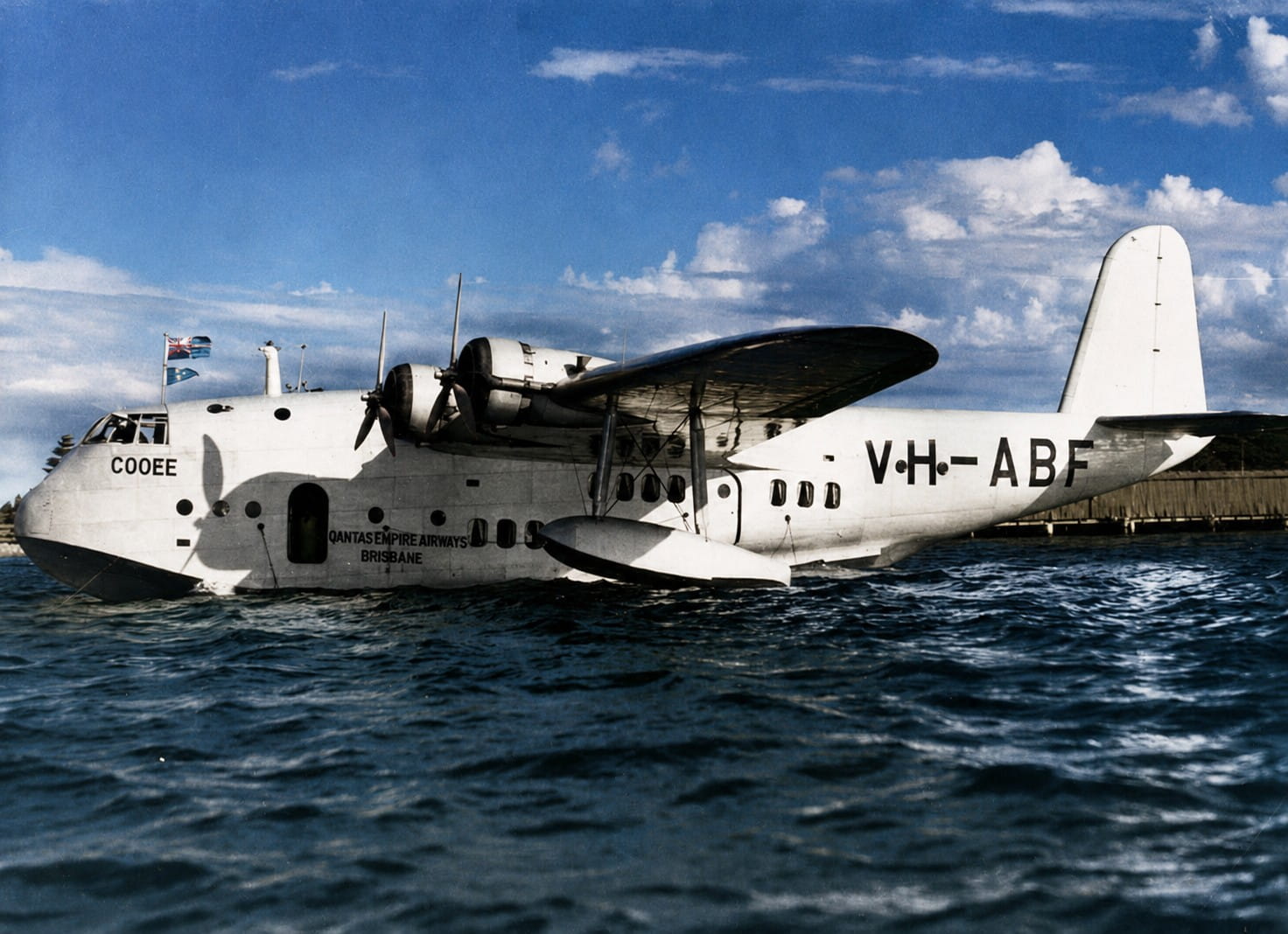
The major companies were now operating predominantly all-metal aircraft, either Douglas or Lockheed types, and Qantas had launched an inspired undertaking which was to bring Australia even closer to the rest of the World. It was during this year that Qantas, together with Imperial Airways Ltd., commenced an Empire flying-boat service from Sydney to the U.K.
Other international services were inaugurated about this time. To link up with the Australian – Great Britain Empire Service, Tasman Empire Airways Ltd. was formed in New Zealand, and operated Empire flying-boats from Auckland to Sydney. The famous island trading company of W.R. Carpenter’s commenced a DH-86 airmail and passenger service between Sydney and Rabaul, in the Mandated Territory of New Guinea.
The Department of Civil Aviation
Towards the end of 1938, the Government found it necessary to replace the Civil Aviation Board with a new organisation. Thus, the Department of Civil Aviation came into being. As its name implies, the new Civil Aviation authority was now a Government Department responsible to a Ministerial head, and under the direct control of the Director-General of Civil Aviation.
D.C.A, as it is known, has performed a sterling service for civil aviation in this Country. The opening of new airports, the establishment of added ground facilities, and the provision of modern navigational aids were only a few of the tasks carried out by D.C.A. To meet changing conditions, new regulations had to be drafted, and, as time went on, the Department had to reorganise itself to cope with the numberless problems associated with all phases of the civil aviation industry.
Civil Aviation at War
By 1942, when Japanese forces were approaching the shores of Australia, the Department and the industry generally had established operation and maintenance facilities of a standard which would be hard to equal elsewhere.
The demands of war had already severely restricted civil flying operations, in fact, most of the heavier civil aircraft had been absorbed into the R.A.A.F., or otherwise used on purely war-work. Many stirring stories are told of the work performed by civil aircraft, and few men are braver than those, the erstwhile civil airpilots, who flew their unescorted, unarmed, and unprotected machines deep into the heart of enemy-held territory to drop supplies or to evacuate civilians of isolated military personnel.
However, the loss of their airfleets left the various companies undaunted. With the same determination which characterised their struggle to found and maintain, most companies reorganised and stood poised, ready to throw their entire resources into the national struggle.
They had not long to wait. Soon after the fall of Corredor, that improvised but gallant little fortress in Manila Bay, the Americans made Australia their forward base in the South West Pacific. Thousands of aircraft poured into the country and almost overnight, the workshops and hangars became chock full of machines and parts being assembled, serviced, or repaired.
The demands for service from the airline facilities were tremendous. Existing skilled staff were completely inadequate, and thousands of men and women were drafted into the industry. Being good material, it was not long before the “dilutees”, as they were called, were welded into skilled and highly competent units eager to take on, and with the potential to carry out, any job from assembling small trainer aircraft to rebuilding shot-up Liberators. Many of these men now hold key positions in the industry.
Supplying the Front and Looking to the Future
As the enemy was pushed further back from Australia, the lines of communication lengthened, and the need arose for personnel and supply-carrying aircraft to fly between Australia and forward bases. Dakota aircraft were loaned to the major airlines, and, with mainly their own crews, these companies commenced operations from Australian bases to New Guinea, Dutch New Guinea, and later, the Phillippine Islands.
In the meantime, the companies, in order to build up their skeleton airline services, acquired aircraft wherever they could. It is interesting to note that towards the middle of 1944, Qantas were operating Cataline flying-boats, Short Empire flying-boats, a Lockheed 10A, and DH-83 and 86 types. A.N.A. at that time, had services extending from Horn Island in the north, right around the coast to Perth, plus many routes to country centres. Aircraft types ranged from DC-3, DC-2, Lockheed 14, and a Stinson A. to DH-89 types.
Towards the end of the war, the companies were able to purchase C-47 aircraft from American disposal sources in Manila. Peace was to find the industry bigger than ever. Justly proud of their war efforts, and anxious to get on with the job of airline business, the companies, whose ranks were swelled by enthusiastic discharged servicemen, looked forward to the coming post-war era with faith in the future of the industry which they themselves had created.